NPCI Unveils Drunix Platform
Economy
Context
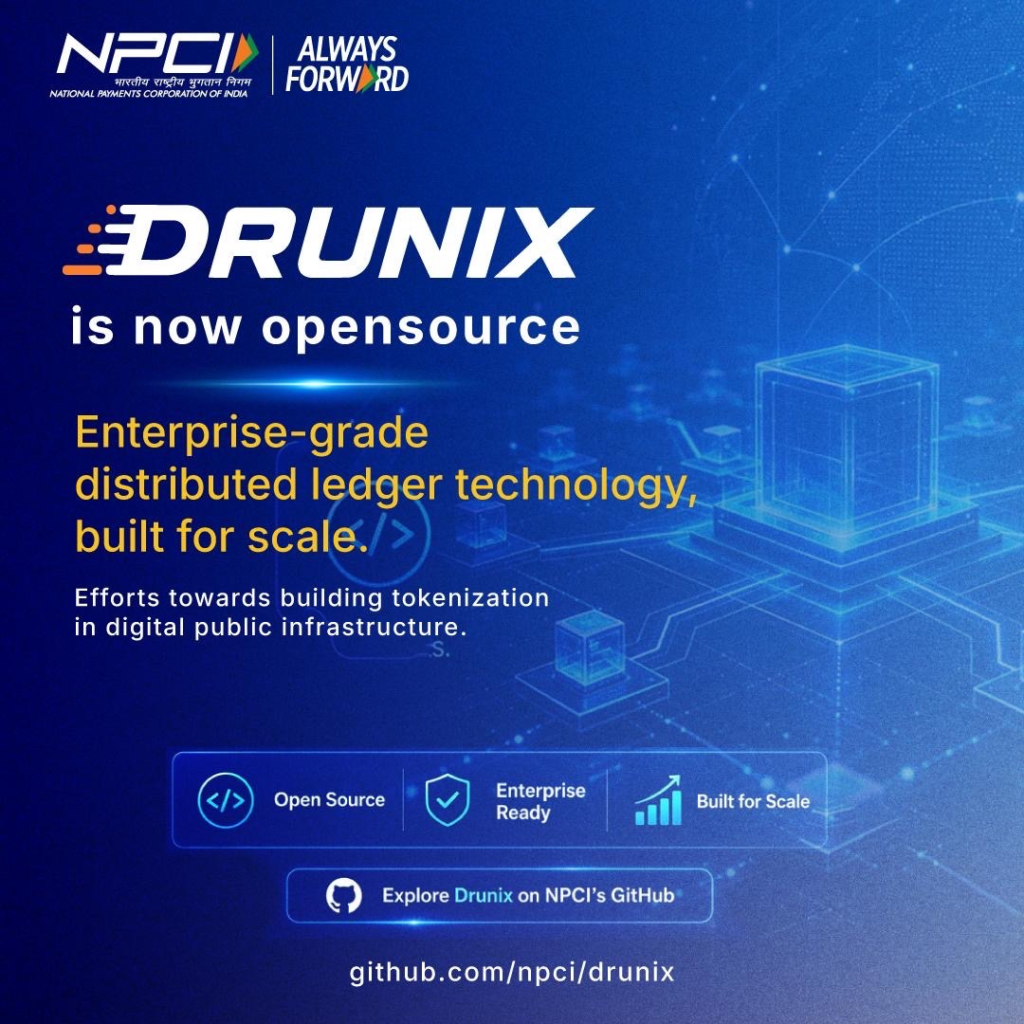
- The National Payments Corporation of India (NPCI) rolled out Drunix,
About –
- It is an open-source blockchain platform, to help companies build and scale tokenisation platforms, digital asset ecosystems, multi-organisation networks.
Significance –
- It helps banks and businesses build safe systems to share data and track digital assets.
- It uses Blockchain: This means data is super safe, shared fairly, and cannot be changed by tricks.
- It is Made in India: India changed a global tool called Hyperledger Fabric to make it faster and better for Indian needs.
- It is Open-Source: The code is free for anyone to see and use. This makes it easy for companies to work together.
Basic terms
- Tokenization – It Tokenization is the process of converting ownership rights or assets into digital tokens on a blockchain.
- These assets include financial securities, real estate, commodities, digital currencies and identity credentials.
- Cryptocurrency – It is a virtual currency used for financial transactions. It uses blockchain technology for various transactions.
- Blockchain – The blockchain is an incorruptible digital ledger of transactions that can be programmed to record virtually everything of value. Each list of records in a blockchain is called a block.
SHe-Box 2.0 Portal Under Mission Shakti
Government Schemes
Context
- The government has highlighted the role of the SHe-Box 2.0 Portal under Mission Shakti in strengthening the implementation of workplace sexual harassment laws and ensuring a safer work environment for women.
SHe-Box
- It is portal that has been developed to operationalise the provisions of the Sexual Harassment of Women at Workplace (Prevention, Prohibition and Redressal) Act, 2013.
- The portal was launched by the Ministry of Women and Child Development (MWCD).
SHe-Box 2.0
- It was launched in 2024.
- Objective – It provides a secure, confidential and user-friendly interface that enables women to report incidents without fear of stigma or retaliation.
- Significance – It provides single-window access for women across all organised, unorganised, public and private sectors to register and track complaints
- The portal is available in 22 languages, including Hindi and English.
Additional Information – Mission Shakti
- This umbrella scheme is dedicated to the safety, security, and economic empowerment of women. It is divided into two sub-schemes:
Sambal (Safety and Security):
- One Stop Centres (OSC): Integrated support for victims of violence.
- Women Helpline (181): 24/7 emergency assistance.
- Beti Bachao Beti Padhao (BBBP): Prevention of gender-biased sex selection and promotion of girls’ education.
- Nari Adalats: Community-level alternative dispute resolution forums.
Samarthya (Empowerment):
- Shakti Sadan: Rehabilitation homes (merging former Swadhar Greh and Ujjawala schemes).
- Pradhan Mantri Matru Vandana Yojana (PMMVY): Maternity benefit scheme.
- Hub for Empowerment of Women (HEW): Facilitating access to government services.
Dark Web
Science & Technology
News
- The Union government submitted before the Delhi High Court that the messaging platform Telegram has evolved into the “new dark web”.
Dark Web
- The dark web is a hidden part of the internet that you cannot find using normal search engines like Google.
- It requires specialized software, such as the Tor browser, to access.
- While it is famous for hiding cybercriminal activities, it is also used for privacy and free speech.
- To understand the dark web, it helps to picture the internet as having three main layers:
- The Surface Web: The everyday internet. These are the websites you can easily search for, like news outlets, social media, and online stores.
- The Deep Web: The much larger portion of the internet that is hidden but not malicious. This includes private databases, online bank accounts, and password-protected email inboxes.
- The Dark Web: A small, specific section of the deep web intentionally hidden by heavy encryption.
Key Features of the Dark Web
- Anonymity: Users and website hosts are hidden. Traffic is routed through a series of encrypted servers to prevent people from tracking identities or locations.
- Special Websites: Instead of ending in .com or .org, dark web sites typically use domains like .onion.
- Legal vs. Illegal Uses: While heavily associated with illicit marketplaces (for illegal goods or stolen data), it is legally accessed by journalists, whistleblowers, and individuals seeking privacy from surveillance in oppressive regimes.
Pradhan Mantri Viksit Bharat Rojgar Yojana (PM-VBRY)
Government Schemes
Context
- The Prime Minister will disburse ₹2,400 crore worth incentives under the Pradhan Mantri Viksit Bharat Rojgar Yojana (PM-VBRY).
About PM-VBRY
- It is a flagship government program launched in 2025
- Implementation – Ministry of Labour & Employment.
- Aim: To promote employment generation, enhance employability, and strengthen social security across all sectors with a particular focus on the manufacturing sector.
Features:
- First-time employees are eligible for incentives of up to ₹15,000.
- For the employer’s side, the government offers a reward of up to ₹3,000 per new employee after six months of stable employment.
- The initiative is expected to encourage greater participation in the formal workforce and contribute to sustained long-term economic growth.
QS Rankings 2027
Economy
Context
- Recently QS (Quacquarelli Symonds) World University Ranking 2027, was released ranking Higher education institutions across the world.
Major Findings
- It evaluated more than 1,500 institutions across 106 countries and territories.
- It features 52 Indian universities, making India the world’s fifth most represented higher education system.
- Global Top 5 Universities dominated by US and UK
- Massachusetts Institute of Technology (MIT), US
- Imperial College London, UK (tied)
- Stanford University, US (tied)
- University of Oxford, UK
- Harvard University, US
Top 10 Indian Institutions (QS World Rankings 2027)
|
Rank |
Institution |
Global Rank |
|
1 |
IIT Delhi |
118 |
|
2 |
IIT Bombay |
134 |
|
3 |
IIT Madras |
170 |
|
4 |
IIT Kharagpur |
205 |
|
5 |
IIT Kanpur |
221 (tied) |
|
5 |
IISc Bengaluru |
221 (tied) |
|
7 |
University of Delhi |
322 |
|
8 |
IIT Roorkee |
335 |
|
9 |
IIT Guwahati |
349 |
|
10 |
Shoolini University |
454 |
Additional Information – QS Rankings
- QS was founded in 1990
- Headquartered in – London.
- It specialises in providing data, research and consulting services to the international higher education sector.
- QS Rankings, established in 2004, is the most reputed Ranking among the major global university rankings and offers an impartial assessment of institutions.
- It assesses institutions across 10 key indicators including academic reputation, employment outcomes, international faculty ratio, international research network, international student diversity, faculty-student ratio and sustainability.
Pradhan Mantri Awas Yojana-Urban 2.0
Government Schemes
Context
- The Union Government has approved over 2.13 lakh additional houses for eligible urban poor families under the Pradhan Mantri Awas Yojana-Urban 2.0 (PMAY-U 2.0).
Pradhan Mantri Awas Yojana-Urban 2.0
- It is a flagship scheme of the Ministry of Housing and Urban Affairs (MoHUA), under which central assistance of up to ₹2.50 lakh crore is provided.
- It was launched in September 2024 as an upgraded and expanded version of PMAY-U, which was launched on 25 June 2015.
- It is open to families belonging to the Economically Weaker Section (EWS), Low Income Group (LIG), and Middle Income Group (MIG) segments who do not own a pucca house anywhere in the country.
The income criteria for eligibility are as follows:
-
- EWS households: Annual income up to ₹3 lakh.
- LIG households: Annual income from ₹3 lakh to ₹6 lakh.
- MIG households: Annual income from ₹6 lakh to ₹9 lakh.
- The cost of house construction is shared among the Centre, States/UTs, Urban Local Bodies (ULBs), and beneficiaries, with the cost-sharing pattern varying across regions.
- PMAY-U and PMAY-U 2.0 together have sanctioned over 1.27 crore houses across the country.
Pradhan Mantri Awaas Yojana–Gramin (PMAY-G)
- Launched by: Ministry of Rural Development (MoRD).
- Background: Introduced on 1 April 2016 by restructuring the erstwhile Indira Awaas Yojana (IAY) to provide pucca houses with basic amenities to rural households.
Exercise KHAAN QUEST 2026
Defence
Context
- The Exercise KHAAN QUEST is going to be conducted from 20 June to 3 July at the Five Hills Training Area in Ulaanbaatar.
About
- The exercise first started as a bilateral event between USA and Mongolian Armed Forces in the year 2003.
- Subsequently, from the year 2006 onwards the exercise graduated to a Multinational Peacekeeping Exercise with the current year being the 23rd iteration.
- The exercise aims to enhance interoperability and cooperation among participating militaries in peace support operations under Chapter VII of the United Nations Charter.