Abhigyan App
Polity
Context
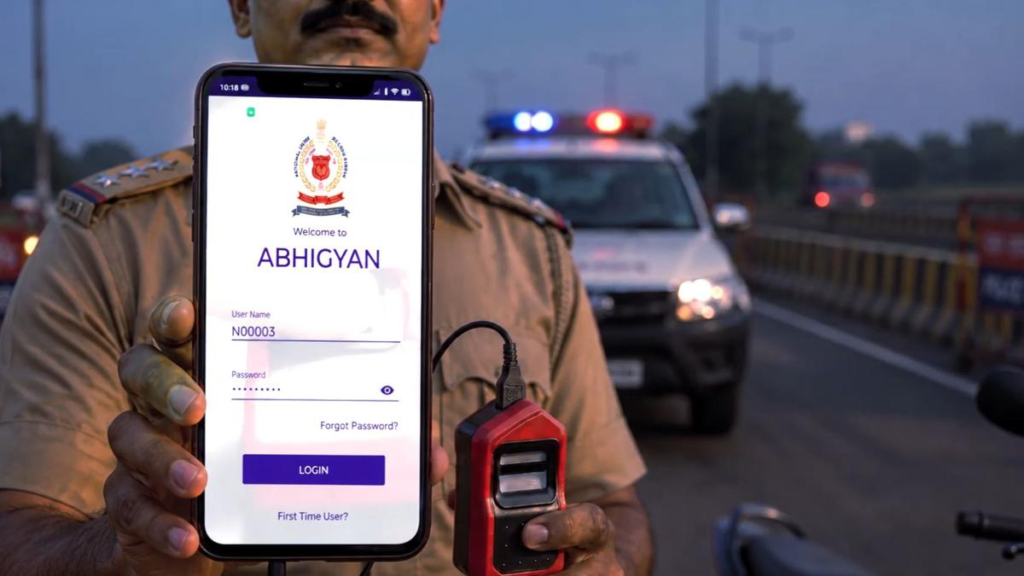
- The Union Home Minister launched the Abhigyan app developed by the National Crime Records Bureau (NCRB).
About
- The app links to the National Automated Fingerprint Identification System (NAFIS) to store fingerprint scans of accused, convicts, and those in prisons on a centralized platform.
- The prints can be matched with the NAFIS database in 35 seconds.
- Significance – During routine vehicle checks on the streets, biometric scans of any suspicious individual can be conducted to identify persons wanted in connection with crimes.
Right To Walk On Footpath Is A Fundamental Right: SC
Polity
Context
- In a landmark judgment, the Supreme Court has held that the right to walk on safe and demarcated footpaths is a fundamental right.
About
- The right to walk flows from Article 19(1)(d) (freedom of movement) and Article 21 (right to life and personal liberty).
- According to the Court, the right to walk also supports freedom of expression, assembly, and association under Article 19(1)(a), 19(1)(b), and 19(1)(c).
- The judgment places a duty on municipal corporations, urban development authorities, municipalities, and even panchayats to build, maintain, and protect pedestrian infrastructure.
- The Court emphasized that pedestrian rights must be prioritized over motorised vehicles in urban planning, and citizens can seek legal remedies if safe and accessible footpaths are not provided.
Energy Transition Index (ETI) 2026
Economy
Context
- According to the Energy Transition Index (ETI) 2026, the global energy transition has effectively stalled despite total energy investments touching $3.3 trillion in 2025.
Energy Transition Index (ETI)
- Published by – It is an annual index published by the World Economic Forum.
- Objective – It measures how effectively countries are transitioning toward secure, sustainable, equitable, and affordable energy systems.
- Evaluation Criteria: The index is based on two broad dimensions:
- System Performance: Energy security, sustainability, and equity.
- Transition Readiness: Policies, regulations, investment, infrastructure, innovation, education, and institutional support.
- Significance: It helps governments identify strengths and weaknesses in their energy transition efforts and guides policy reforms.
Major Findings of Energy Transition Index (ETI) 2026
-
- Sweden, Finland and Denmark retained their top three positions globally.
- India advanced two places to rank 70th.
Financial Action Task Force (FATF)
International
Context
- The Financial Action Task Force (FATF) Plenary has appointed Culture Ministry Secretary Vivek Aggarwal as the next vice-president.
- This is the first time that India will hold the Vice-Presidency of the FATF.
- He will serve as vice president from July 2026 to June 2027.
Financial Action Task Force
- Established – The Financial Action Task Force (FATF) is an inter-governmental body established in 1989 during the G7 Summit in Paris.
- Objective – To set standards and promote effective implementation of legal, regulatory and operational measures for combating money laundering, terrorist financing and other related threats to the integrity of the international financial system.
- Secretariat – It is located at the Organisation for Economic Cooperation and Development (OECD) headquarters in Paris.
- Member Countries – 37 member countries where India is also a member.
FATF has two lists
- Grey List – Countries that are considered safe haven for supporting terror funding and money laundering are put in the FATF grey list. This inclusion serves as a warning to the country that it may enter the blacklist.
- Black List – Countries known as Non-Cooperative Countries or Territories (NCCTs) are put in the blacklist. These countries support terror funding and money laundering activities. The FATF revises the blacklist regularly, adding or deleting entries.
Smart Seed Coating Technology to Boost Crop Yields
Science & technology
Context
- The Indian Council of Agricultural Research’s Indian Institute of Oilseeds Research (ICAR-IIOR), Hyderabad, has developed Smart Seed Coating Technology that improves seed quality.
Smart Seed Coating Technology
-
- Developed by – ICAR-IIOR
- It utilizes biodegradable biopolymeric materials to create a multifunctional protective layer around seeds.
- The coating acts as a carrier system for beneficial microorganisms, nutrients, micronutrients, crop protection agents, and plant growth-promoting compounds, delivering them directly at the seed-soil interface.
- This protective microenvironment promotes rapid germination, vigorous seedling growth, enhanced root development, and improved tolerance to environmental stresses during the critical crop establishment phase.
- The innovation is particularly valuable for rainfed agriculture, which accounts for a significant share of India’s cultivated area and remains highly vulnerable to delayed monsoons.