Author: Ramvilas
-
Buxa Tiger Reserve | G7 Nations to Release 100 Million Barrels of Oil
Buxa Tiger Reserve
Environment
Context
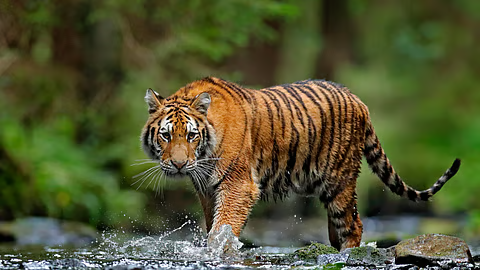
- A three-year-old tigress, T138, has been released into West Bengal’s Buxa Tiger Reserve, marking the beginning of a phased tiger reintroduction programme to establish a self-sustaining tiger population.
Buxa Tiger Reserve
-
- Location: Alipurduar district, northern West Bengal, along the India–Bhutan border.
- Established: Declared a Tiger Reserve in 1983 under Project Tiger.
- Ecological significance:
- Located in the Eastern Himalayan foothills.
- Provides ecological linkages with forests of Assam and Bhutan.
-
- Important fauna: Asian elephant, gaur, sambar, clouded leopard, Indian leopard and Asian golden cat.
- Tiger status: Historically faced a prolonged absence of a stable resident tiger population due to habitat degradation, fragmentation and reduced prey availability.
- Rivers:
- Sankosh River: Forms part of the eastern boundary along the Assam border.
- Jayanti River: Important seasonal river flowing through the Buxa landscape.
Additional Information – Project Tiger
- Launched in 1973 with 9 tiger reserves.
- Legal basis: Tiger Reserves are constituted under the Wildlife (Protection) Act, 1972, particularly after the 2006 amendment.
- NTCA: Established in 2006 as a statutory body for tiger conservation.
- Core area: Legally designated as Critical Tiger Habitat (CTH); receives the highest protection.
- Buffer area: Peripheral area adjoining the core, aimed at promoting coexistence and reducing pressure on the core.
- Tiger Census: Conducted every 4 years under the All India Tiger Estimation (AITE).
- Latest national tiger estimate: 3,682 tigers (2022).
- Highest tiger population: Madhya Pradesh, followed by Karnataka and Uttarakhand (2022 estimate).
- Largest Tiger Reserve by area: Nagarjunsagar-Srisailam (Andhra Pradesh–Telangana landscape).
- Smallest Tiger Reserve: Bor Tiger Reserve, Maharashtra.
- First Tiger Reserve: Jim Corbett Tiger Reserve, Uttarakhand.
- Newest tiger reserves: India has continued adding reserves under Project Tiger; the exact total changes with new notifications.
- Tiger reserves are not necessarily National Parks: A tiger reserve can include National Parks, Wildlife Sanctuaries and other forest areas.
- Global significance: India contains the largest share of the world’s wild tiger population.
G7 Nations to Release 100 Million Barrels of Oil
International
Context
- The Group of Seven (G7) nations have agreed to release 100 million barrels of oil over four months to ease soaring fuel prices, with a substantial release of diesel planned in the first 20 days.
Group of Seven (G7)
- G7: Informal grouping of 7 major advanced economies.
- Members: France, Germany, Italy, Japan, UK, USA and Canada.
- Origin: Emerged from the 1973 oil crisis.
- Initial Group of Five (G5): France, West Germany, USA, UK and Japan.
- Canada joined: 1976 → G7.
- EU: Began participating in 1977; EU is not a G7 member, but participates in meetings.
- G8 phase: Russia joined in 1997, making it G8.
- Back to G7: Russia ceased to be part of the group in 2014 following the annexation of Crimea.
- Nature: Informal grouping, not a treaty-based international organisation.
- Presidency: Rotates annually among member countries.
- Key areas: Global economy, trade, security, climate change, energy, development and geopolitical issues
Additional Information – International Energy Agency (IEA)
- Established: 1974, in response to the 1973–74 oil crisis.
- Headquarters: Paris, France.
- Parent framework: Operates within the framework of the OECD.
- Members: 32 member countries.
- India: Association country, not a full IEA member.
- Other Association countries: China, Indonesia, Singapore, South Africa, Thailand etc.
- Main objective: Ensure energy security and coordinate responses to major disruptions in oil supply.
-
GOBARdhan Scheme | Great Indian Bustards | India-specific tool to predict Sickle Cell Anaemia severity
GOBARdhan Scheme
Environment
News
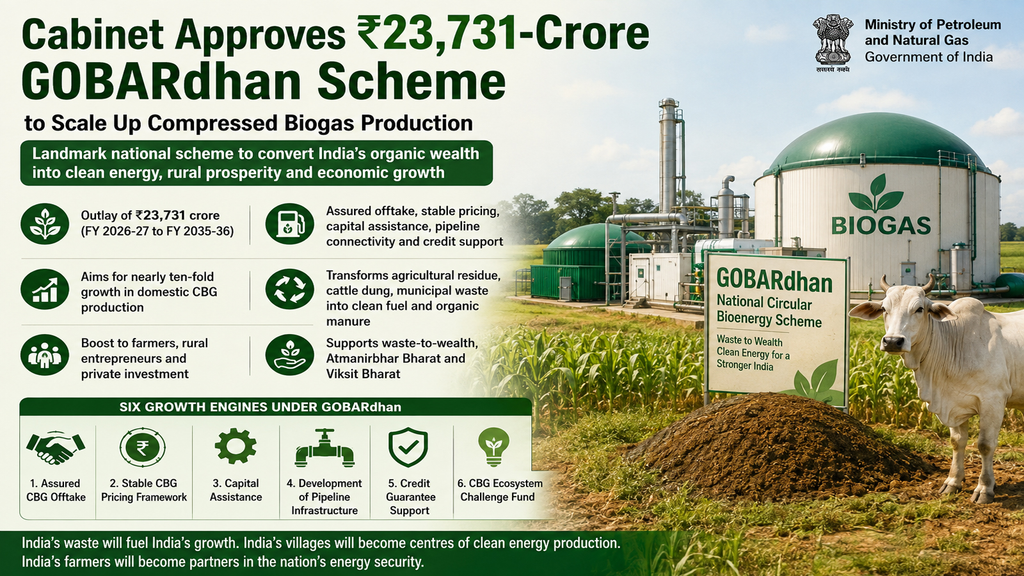
- The Union Minister of Petroleum and Natural Gas launched the GOBARdhan Scheme for development of the Compressed Biogas (CBG) sector.
The GOBARdhan (National Circular Bioenergy Scheme)
- It is a 10-year initiative (FY 2026–27 to 2035–36)
- Implementation – Ministry of Petroleum and Natural Gas
Key Objectives & Components
- Target: Boost Compressed Biogas (CBG) production tenfold to 5 MMSCMD.
- Unified Framework: Consolidates previous initiatives like SATAT, Market Development Assistance (MDA), and Biomass Aggregation Machinery (BAM).
Additional Information – Biofuels
-
- Definition – Biofuels are alternative fuels made from plant and plant-derived resources.
- Example: Bioethanol, Biodiesel, Green diesel, Biogas etc.
National Policy on Biofuels, 2018
- The National Policy on Biofuels 2018 (amended in 2022) provides a framework for increasing the use of biofuels in India to enhance energy security.
Government Efforts for Biofuel Expansion
- Pradhan Mantri JI-VAN Yojana (Jaiv Indhan – Vatavaran Anukool fasal awashesh Nivaran Yojana): It promotes 2G ethanol production from agricultural waste and residues.
- SATAT Scheme (Sustainable Alternative Towards Affordable Transportation): It promotes Compressed Bio-Gas (CBG) production as a fuel alternative.
Great Indian Bustards
Environment
News
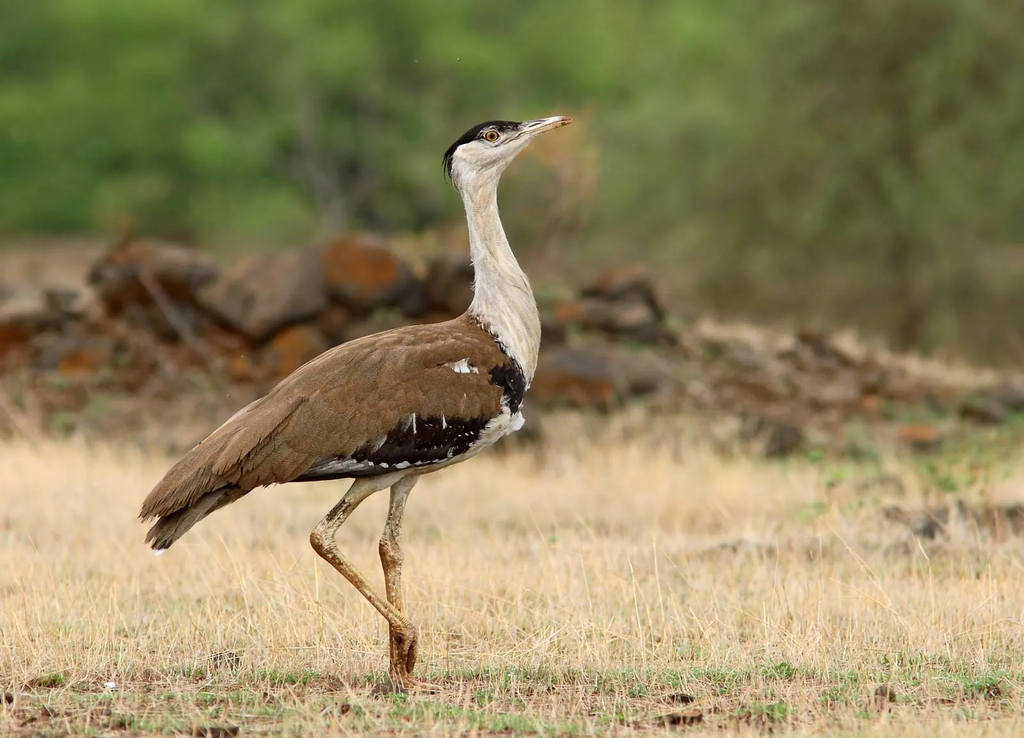
- Ten captive-bred Great Indian Bustards (GIBs) are set to be released into their natural habitat in Rajasthan’s Jaisalmer as part of an effort to rebuild the species’ wild population.
Great Indian Bustard (GIB)
- Scientific name: Ardeotis nigriceps
- Size: Large ground bird; about 1 m tall and 15–18 kg.
- Ecological significance: Keystone species of arid and semi-arid open ecosystems.
- Population: Critically low; latest estimates indicate about 130 ± 20 in Rajasthan, with only 5–6 individuals across Gujarat, Maharashtra and Karnataka.
- State bird: Rajasthan.
Conservation Status
-
IUCN: Critically Endangered
-
Wildlife (Protection) Act, 1972: Schedule I
-
CITES: Appendix I
-
CMS: Listed under the Convention on Migratory Species.
Major Threats
-
Habitat loss and fragmentation
-
Poaching
-
Predation of birds and eggs
-
Collision with overhead power transmission lines, particularly those associated with renewable-energy projects.
Power Lines & Supreme Court
-
Power-line collisions have emerged as a major conservation challenge in GIB habitats.
-
The Supreme Court has directed that renewable-energy project power lines in specified GIB areas outside the Desert National Park (DNP) be shifted underground, with implementation targeted by December 2027
.
India-specific tool to predict Sickle Cell Anaemia severity
Science and Tech
News
- Scientists at the CSIR-Centre for Cellular and Molecular Biology (CCMB) have developed an India-specific disease severity score for sickle cell anaemia (SCA).
Sickle cell anaemia
-
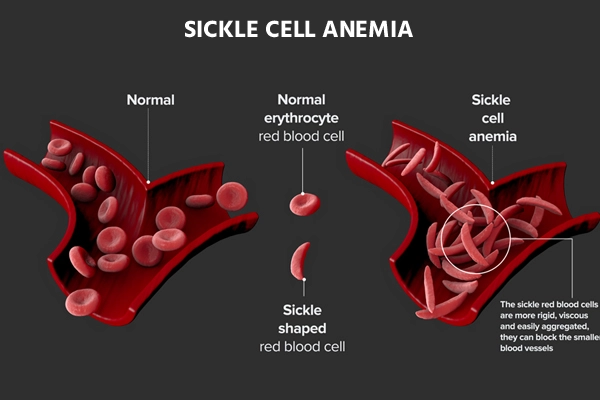
- Disease – It is an inherited group of blood disorders that is genetic in nature.
- Cause – It is caused by a mutation in the hemoglobin-β gene found on chromosome 11. This mutation results in defective haemoglobin (Hb).
- Characteristics – After giving up oxygen, these defective Hb molecules cluster together resulting in formation of rod like structures.
- The red blood cells become stiff and assume sickle shape. (Haemoglobin (Hb) is a protein found in the red blood cells that carries oxygen in your body and gives blood its red colour)
- Transmission – It is usually transferred from the parents to the child during birth i.e. both parents can be carriers of SCDs.
- Symptoms – Babies who are born with sickle cell anaemia might not show symptoms for many months.
- Extreme tiredness, fussiness and painfully swollen hands and feet and jaundice.
- Effects – The misshapen cells lack plasticity and can block small blood vessels, impairing blood flow.
- The sickle cells die prematurely, resulting in a chronic lack of red blood cells (anaemia), often called sickle-cell anaemia.
- Treatment – Medication, blood transfusions and rarely a bone-marrow transplant are done.
-
Southwest Monsoon Ends with 12% Deficit | Sengol | Rebate of State and Central Taxes and Levies (RoSCTL) Scheme | ASEAN-India Maritime Exercise (AIME-2026) | Increase in the Minimum Support Prices (MSP) for all mandated Rabi crops | SC/ST (Prevention of Atrocities) Act, 1989 | ‘Beamline for Schools’ Competition | Bond Yield
Southwest Monsoon Ends with 12% Deficit
Geography
Context
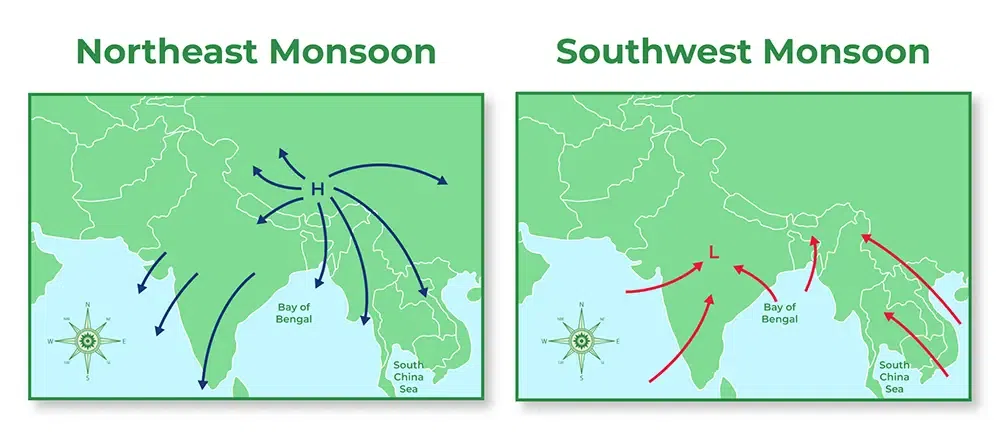
- As per the India Meteorological Department (IMD) India’s 2026 southwest monsoon ended with 759.4 mm of rain, 12.6% below the 868.6 mm normal.
Southwest Monsoon
- Onset and Retreat: The monsoon season in India generally starts in early June and lasts until September.
- The onset of the monsoon is marked by the arrival of the southwest monsoon winds, which bring moisture-laden air from the Indian Ocean.
- The withdrawal or retreat of the monsoon typically begins in October.
- The northeast monsoon, occurring from October to December, brings rainfall to parts of southern India.
- Monsoon Dynamics: Factors such as the El Niño and La Niña phenomena can influence the strength and distribution of the monsoon.
- Agricultural Impact: The success of the monsoon directly influences crop yields and, consequently, the overall economy of the country.
Connect with the basics- Difference between El Niño and La Niña
Feature
El Niño (Warm Phase)
La Niña (Cold Phase)
Meaning
Spanish for “Little Boy”
Spanish for “Little Girl”
Ocean Temp.
Abnormal warming of eastern Pacific
Abnormal cooling of eastern Pacific
Trade Winds
Weaken or reverse direction
Become unusually strong
Indian Monsoon
Weakens monsoon; often leads to droughts
Strengthens monsoon; brings heavy rainfall
Winter in India
Generally warmer/milder winters
Severely cold winters in North India
Frequency
Occurs every 2–7 years; lasts 9–12 months
Occurs every 2–7 years; can last 1–3 years
Sengol
History
News
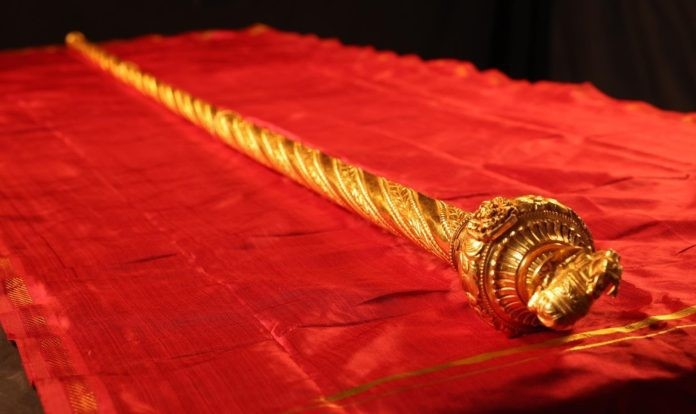
- The newly released NCERT Class 9 Social Science textbook, Understanding Society and Beyond – Part 2, shows the Sengol as a symbol of righteous governance.
Sengol (or Chenkol)
- Sengol/Chenkol: Traditional Tamil royal sceptre, symbolising righteousness (dharma), justice, legitimate authority and accountable governance.
- Origin: Tamil Nadu; associated with the ceremonial traditions of Tamil rulers.
- Historical associations: Linked with the Cholas, Madurai Nayakas (including the Meenakshi tradition) and the Sethupatis of Ramnad, who received ritually sanctified sceptres from Rameswaram temple priests.
- Symbolism: Represents the ruler’s duty, service, ethical conduct and responsibility towards the people.
- 1947 association: According to the NCERT/Union Ministry of Culture account, Shaivite Adheenam saints presented a Sengol to Jawaharlal Nehru around Independence as a symbol of the transfer of authority from British rule to independent India.
- Historical debate: Historians, including Rajmohan Gandhi, have questioned whether the Sengol was formally recognised as the official symbol of the transfer of power, noting the absence of such a record in Nehru’s and C. Rajagopalachari’s papers/writings.
- Significance: Illustrates the idea of ethical and dharmic kingship in Tamil political-cultural traditions.
Rebate of State and Central Taxes and Levies (RoSCTL) Scheme
Economy
News
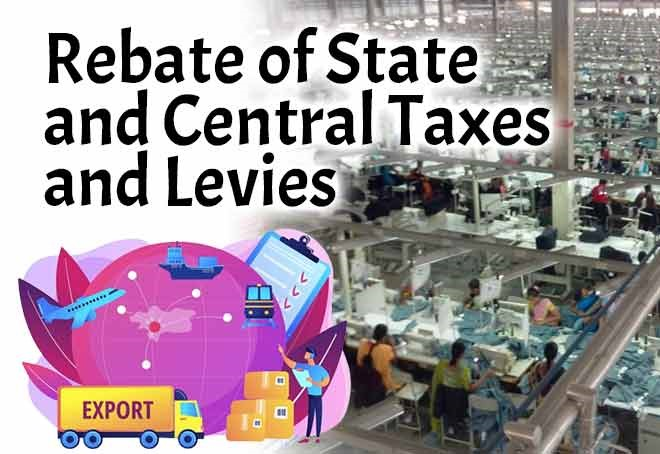
- The Ministry of Textiles has extended the RoSCTL Scheme for exports of apparel/garments and made-ups for a further term of three months, from 1st October to 31st December 2026.
Rebate of State and Central Taxes and Levies (RoSCTL) Scheme
- Launched: 2019, Ministry of Textiles.
- Objective: Rebates embedded/unrefunded State and Central taxes & levies on exported textile products that are not covered under other schemes.
- Principle: Zero-rating of exports → ensures taxes embedded in exported products are remitted/refunded.
- Focus: Supports apparel and made-up exports, particularly MSME exporters.
Importance:
- Enhances global competitiveness of India’s labour-intensive textile sector.
- Supports MSME participation in global markets.
- Promotes a dispersed manufacturing ecosystem across regions.
- Provides policy continuity and predictability to exporters.
ASEAN-India Maritime Exercise (AIME-2026)
Defence
News
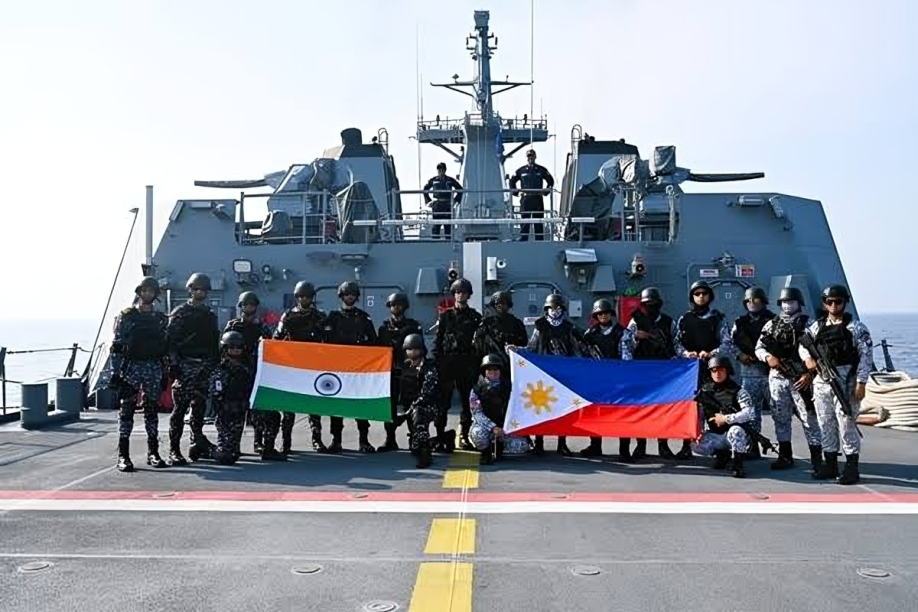
- The Second Edition of the ASEAN-India Maritime Exercise (AIME-2026) commenced at Subic Bay, Philippines.
ASEAN–India Maritime Exercise
- AIME: ASEAN–India Maritime Exercise; brings together Indian Navy and ASEAN maritime forces.
- Theme: “Anchored in Trust, United at Sea.”
- Objective: Enhance mutual understanding, cooperation, operational coordination and interoperability.
- India’s Participation – INS Sahyadri and INS Kulish participated in AIME-2026.
Significance:
- Strengthens India–ASEAN maritime cooperation.
- Supports India’s Act East Policy.
- Advances MAHASAGAR — Mutual and Holistic Advancement for Security and Growth Across Regions.
- Promotes a free, open and cooperative maritime environment in the Indo-Pacific.
Increase in the Minimum Support Prices (MSP) for all mandated Rabi crops
Economy
News
- The Cabinet Committee on Economic Affairs (CCEA) has approved the increase in the Minimum Support Prices (MSP) for all mandated Rabi Crops for Marketing Season 2027-28.
Minimum Support Prices (MSPs)
- Definition – It is a form of market intervention by the Government of India to insure agricultural producers against any sharp fall in farm prices.
- Announcement and Recommendation – The Cabinet Committee of Economic
Affairs announces the MSP at the start of each sowing season, taking into account the recommendations of the Commission for Agricultural Costs and Prices (CACP)
- Significance – MSP protects the producer- farmers against distress sale during bumper production years.
Crops Covered
- The Centre announces the MSP (which is not legally guaranteed) for 22 mandated crops and Fair & Remunerative Price for sugarcane.
These include
- 14 kharif crops – paddy, jowar, bajra, maize, ragi, tur/arhar, moong, urad, groundnut, soyabean, sunflower, sesamum, niger seed, cotton,
- 6 rabi crops – wheat, barley, gram, masur/lentil, rapeseed and mustard, and safflower
- 2 commercial crops – Jute and Copra
Fair and Remunerative Price (FRP) of sugarcane
- Recommended by – Commission for Agricultural Costs and Prices (CACP)
- Objective – to assure margins on account of profit and risk to farmers, irrespective of the fact whether sugar mills generate profit or not.
SC/ST (Prevention of Atrocities) Act, 1989
Polity
Context
- The Calcutta High Court has observed that casteist abuses on social media can attract the provisions of the SC/ST (Prevention of Atrocities) Act, 1989, saying the “public view” under the Act cannot be confined to physical venues only.
SC/ST (Prevention of Atrocities) Act, 1989
- Enacted: 1989; came into force in 1990.
- Aim: Prevent atrocities against SCs/STs and provide speedy justice, relief and rehabilitation.
- Key features:
- Defines and penalises specific atrocities.
- Special/Exclusive Special Courts for speedy trials.
- Protection and rights for victims and witnesses.
- Relief and rehabilitation for victims.
- 2015 Amendment: Expanded offences and strengthened victim/witness safeguards.
- 2018 Amendment: No preliminary enquiry for FIR registration and no prior approval for arrest under the Act.
- Significance: Legal safeguard against caste-based violence and discrimination.
‘Beamline for Schools’ Competition
Science and Technology
Context
- A group of Indian school students is among the five winning teams of the 13th edition of the ‘Beamline for Schools’ competition.
Beamline for Schools Competition
- Organised by: CERN for high-school students worldwide.
- Aim: Allows students to conduct experiments using a particle beamline.
- Beamline: Facility providing high-energy beams of subatomic particles for experiments.
- Example experiment: Study pion charge exchange—conversion of charged pions into neutral pions when interacting with light atoms like lithium and beryllium.
- Pions: Subatomic particles with positive, negative or zero charge.
CERN
- Full form: European Organization for Nuclear Research.
- Location: Near Geneva, Switzerland, Franco-Swiss border.
- Established: 1954 for peaceful cooperation in fundamental research.
- Governance: Managed by Member States through the CERN Council.
- LHC: World’s largest and most powerful particle accelerator.
- Higgs boson: Major role in its 2012 discovery, supporting the Higgs mechanism of particle mass.
Bond Yield
Economy
Context
- The yield on the 30-year US Treasury bond hit the highest level in around 25 years.
About
- Meaning: Return an investor expects from holding a bond.
- Inverse relationship: Bond Price ↑ → Yield ↓; Bond Price ↓ → Yield ↑.
- Rise in yield: Usually indicates investors demand higher returns, often due to inflation concerns, higher interest-rate expectations or increased government borrowing.
Impact of higher yields:
- Increases government borrowing costs.
- Can attract capital towards bonds, affecting capital flows and exchange rates.
- Higher benchmark yields can raise borrowing costs globally.
- May put pressure on equity markets as bonds become relatively more attractive.
-
Karnataka & Group C Current Affairs – September 22nd to September 26th, 2026
Appointments
Mandeep K Bhandari Appointed New CBSE Chairperson
Senior IAS officer Mandeep K Bhandari (2001-batch AGMUT cadre) has been appointed as the new Chairperson of the Central Board of Secondary Education (CBSE) by the Appointments Committee of the Cabinet (ACC). He replaces interim chief Lokhande Prashant Sitaram, taking charge of the national education board at a critical juncture as it navigates administrative reforms following the recent controversies surrounding its digital On-Screen Marking (OSM) evaluation system.
Awards
1. Z T Lalrithangi Named Among FAO’s 100 Women Heroes
Context: Mizoram farmer Z T Lalrithangi has been globally recognized for advancing agrifood systems and rural livelihoods.
Key Highlights:
- Award: 100 Women Heroes in Agrifood Systems and Rural Development.
- Awardee: Z T Lalrithangi (Sangau, Mizoram); the first Mizo and one of two Indian women selected from 600+ nominations across 131 nations.
- Issuing Authority: UN Food and Agriculture Organization (FAO).
- Presenter / Venue: World Food Forum at FAO headquarters, Rome, Italy.
- Key Achievement: Pioneered commercial strawberry farming and value-added agro-products (strawberry wine, dried fruits), serving as a scalable model for rural economic diversification.
About the Award:
- Aligned with the UN’s International Year of the Woman Farmer 2026.
- Recognizes grassroots women leaders closing gender gaps and transforming agrifood systems globally.
2. Shantanu Moitra to Receive National Lata Mangeshkar Award
Context: Renowned music director and composer Shantanu Moitra has been honoured for his exceptional lifetime contributions to Indian film music.
Key Highlights:
- Award: National Lata Mangeshkar Award (2026).
- Awardee: Shantanu Moitra (Music Composer, acclaimed for soundtracks like Parineeta and 3 Idiots).
- Issuing Authority: Culture Department, Government of Madhya Pradesh.
- Presenter / Venue: To be presented at a formal ceremony in Indore, Madhya Pradesh (the birthplace of the legendary singer Lata Mangeshkar).
- Key Achievement: Recognized for his distinctive, melody-driven compositions and enduring impact on contemporary Hindi cinema.
About the Award:
- Instituted in 1984 by the Madhya Pradesh Government to promote excellence in light music.
- Conferred alternately upon music directors and playback singers on an annual basis.
- Comprises a cash prize of ₹5 lakh, a citation of merit, and a traditional shawl/shriphal.
Important Days
1. World Rhino Day
- Observed Date: September 22
- Observing Organisation: World Wildlife Fund (WWF)
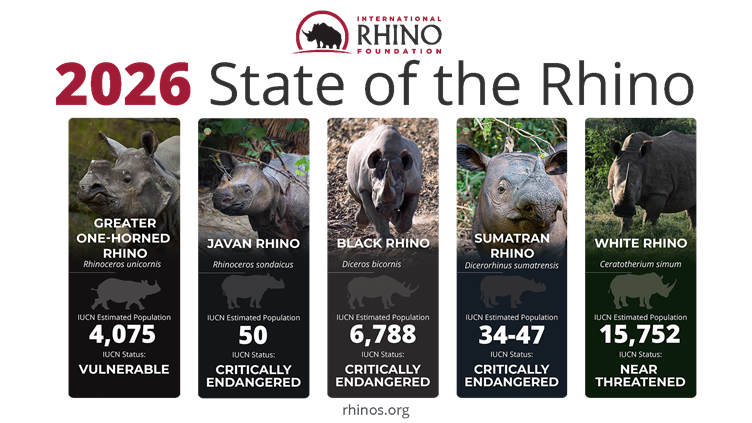
- Objective: To raise global awareness about the conservation of the five surviving rhinoceros species (White, Black, Greater One-Horned, Javan, and Sumatran) and highlight threats from poaching and habitat loss. India serves as the primary stronghold for the Greater One-Horned Rhino (IUCN: Vulnerable), hosting over 4,075 individuals, primarily in Assam (Kaziranga National Park and Pobitora WLS).
- Theme: “Keep the Five Alive”
2. 11th Ayurveda Day
- Observed Date: September 23
- Observing Organisation: Ministry of Ayush (Government of India)
- Objective: To promote the integration of India’s traditional medicine system into modern healthcare and preventive wellness, while highlighting the growth of the AYUSH ecosystem through the National Ayush Mission (NAM).
- Theme: “Ayurveda for a Healthier Tomorrow” (स्वस्थ भविष्य के लिए आयुर्वेद)
3. Bhikaji Cama Birth Anniversary
- Observed Date: September 24
- Observing Organisation: Government of India
- Objective: To commemorate the “Mother of the Indian Revolution” for her vital contributions to the nation’s freedom struggle, most notably for being the first person to unfurl an early version of the Indian national flag on foreign soil (at the 1907 International Socialist Congress in Stuttgart, Germany), and for supporting exiled revolutionaries by co-founding the Paris Indian Society.
4. Pandit Deendayal Upadhyaya Birth Anniversary (Antyodaya Diwas)
- Observed Date: September 25
- Observing Organisation: Government of India
- Objective: To commemorate the birth anniversary of visionary thinker Pandit Deendayal Upadhyaya and promote his guiding socio-economic philosophies of ‘Integral Humanism’ and ‘Antyodaya’ (uplifting the poorest of the poor) to drive inclusive, grassroots-level welfare.
5. 85th CSIR Foundation Day
- Observed Date: September 26
- Observing Organisation: Council of Scientific and Industrial Research (CSIR)
- Objective: To commemorate the establishment of India’s largest public R&D organization in 1942 (founded by Shanti Swarup Bhatnagar and A.R. Mudaliar), and to celebrate its 85 years of pioneering contributions to science, technology, and industrial research, typically marked by the announcement of the prestigious Shanti Swarup Bhatnagar (SSB) Prizes.
Ranks & Reports
1. NIRF SDG Rankings: Top Institutes for Sustainable Development
-
- Released By: Ministry of Education, Government of India (NIRF).
- Key Observations: Evaluates institutions across 17 UN Sustainable Development Goals (Agenda 2030), measuring environmental sustainability, clean energy innovation, resource stewardship, and community impact alongside academic outcomes.
- Performance Metric:
-
- IIT Madras: National Rank: 1st | Green technology & sustainable research
- IARI, New Delhi: National Rank: 2nd | Sustainable agriculture & food security
- Jamia Millia Islamia: National Rank: 3rd | Social inclusion & environmental studies
2. WEF Travel and Tourism Development Index 2026Released By: World Economic Forum (WEF) (in partnership with Zurich Insurance Group).
Key Observations: Evaluates 110 economies across 17 pillars determining sustainable tourism growth. India climbed nine spots to 31st, driven by price competitiveness, rich cultural assets, and expanding transport infrastructure. Japan leads globally, with advanced economies capturing nine of the top 10 positions.
Performance Metric:
- Japan: Global Rank: 1st
- United States: Global Rank: 2nd
- Spain: Global Rank: 3rd
- India: Global Rank: 31st (up from 39th in 2024)
3. Oxford Economics Global Cities Index 2026
Released By: Oxford Economics
Key Observations: Evaluates the world’s 1,000 largest cities across Economics, Human Capital, Quality of Life, Environment, and Governance. New York leads globally. Delhi is India’s top-ranked city at 268th, buoyed by high Human Capital (13th) despite lower standings in Environment and Quality of Life.
Performance Metric:
- New York: Global Rank: 1st
- London: Global Rank: 2nd
- Paris: Global Rank: 3rd
- Delhi: National Rank: 1st | Global Rank: 268th
- Bengaluru: National Rank: 2nd | Global Rank: 311th
- Mumbai: National Rank: 3rd | Global Rank: 330th
Military Exercises
1. Exercise NOMADIC ELEPHANT
Context: The 18th edition of the India-Mongolia joint military exercise commenced to enhance bilateral interoperability and tactical skills for counter-insurgency scenarios.
Salient Features:
Parameter
Key Details
Participating Nations
India and Mongolia
Edition & Venue
18th Edition (2026) at the Foreign Training Node, Pithoragarh, Uttarakhand
Frequency
Annual bilateral exercise (alternating venues; previous edition held in Ulaanbaatar in 2025)
Inception
Conducted since 2006
Core Objective
Joint Counter-Insurgency Operations in semi-urban and mountainous terrain under the United Nations Mandate
2. Exercise TARANG SHAKTI
Context: The Indian Air Force is hosting the second edition of its largest multinational air exercise to enhance international interoperability and joint combat operations in a realistic contemporary battlespace.
Salient Features:
Parameter
Key Details
Hosting Force
Indian Air Force (IAF)
Participating Nations
8 nations with air assets (Australia, Bangladesh, France, Germany, Greece, Sri Lanka, UAE, USA) alongside 32 observer nations
Edition & Venue
2nd Edition (2026) at Air Force Station, Jodhpur, Rajasthan (and adjoining air bases)
Background
The inaugural 1st edition was conducted in 2024 across two phases in Sulur (Tamil Nadu) and Jodhpur
Core Objective
Planning and executing multinational joint combat operations, deriving tactical solutions, and fostering strategic military cooperation
3. Exercise ‘Pitch Black’ and Exercise ‘Udara Shakti’
Context: The Indian Air Force (IAF) successfully concluded a strategic dual-deployment, participating in the multinational Exercise Pitch Black in Australia before proceeding directly to Malaysia for the bilateral Exercise Udara Shakti.
Salient Features:
Parameter
Exercise Pitch Black
Exercise Udara Shakti
Type & Host
Multinational exercise hosted by the Royal Australian Air Force (RAAF)
Bilateral exercise hosted by the Royal Malaysian Air Force (RMAF)
Participating Forces
20+ partner nations alongside the IAF
Indian Air Force (IAF) and RMAF
Location
Australia
Subang, Malaysia
Operational Focus
Complex Large Force Employment (LFE) missions across a high-threat, multi-domain environment
Refining air combat tactics, Subject Matter Expert Exchanges (SMEE), and combined operational flexibility
IAF Fleet Deployment
Featured the deployment of frontline Rafale fighter aircraft
Included joint tactical manoeuvres flying with and against Su-30MKM and F/A-18 Hornet aircraft
Miscellaneous
Khair Tree (Acacia catechu)
Context: The species was recently highlighted in the news due to its extraction through an alleged ₹120 crore interstate smuggling network operating in the forests of Western Odisha.
Salient Features:
Parameter
Key Details
Botanical Family
Fabaceae (a nitrogen-fixing family known for enhancing soil fertility)
Habitat & Distribution
One of the most important native tree species across the Indian subcontinent
Primary Extract
Yields Katha (catechu extract) derived from its heartwood, a staple ingredient used in paan across India
Economic Significance
Highly valued for timber durability, medicinal properties, and its role in traditional industries
-
Global Cities Index 2026 | Organisation for Economic Co-operation and Development (OECD) | PB-SHABD | Pandit Deendayal Upadhyaya | Hurricane Polo (DDN) | DURGA Scheme
Global Cities Index 2026
International
News –
- Oxford Economics released its 2026 Global Cities Index,
Global Cities Index 2026
-
Released by: Oxford Economics.
-
Coverage: 1,000 largest cities across 163 countries.
-
Significance: These cities represent 60% of global GDP and 30% of global population.
-
Assessment: 27 indicators under 5 categories:
-
Economics – 30%
-
Human Capital – 25%
-
Quality of Life – 25%
-
Environment – 10%
-
Governance – 10%
-
-
Purpose: Measures cities’ economic performance, human capital, living conditions, environmental sustainability and governance.
Key Findings
-
Top 3: New York, London and Paris retained the top three positions.
-
Western dominance: 78 of the top 100 cities are in Europe and North America.
-
Asia rising: Asian cities are driving global urban growth, particularly Chinese and Indian cities, supported by population scale, productivity and income gains.
-
India: Delhi is currently outside the top 100 but is projected to record one of the largest GDP increases by 2050.
-
Bengaluru: Identified as a “City to Watch”, with rapid growth linked to its IT sector and emerging opportunities in AI.
Organisation for Economic Co-operation and Development (OECD)
International
News –
- Organisation for Economic Co-operation and Development (OECD) released its Interim Economic Outlook, upgrading its growth projection for India.
OECD
- Established: 1961; headquarters Paris, France.
- Nature: Intergovernmental organisation promoting economic growth, trade and international standards.
- Members: 38 countries, largely high-income market democracies.
- India: Not a member; one of 5 Key Partners — Brazil, China, Indonesia, South Africa.
- India–OECD: Participates in committees, policy surveys and global tax initiatives.
PB-SHABD
Polity
Context (PIB):
- The Ministry of Information and Broadcasting (MIB) highlighted PB-SHABD’s adoption by over 3,600 media organisations and extended free access until March 2027.
PB-SHABD
- Launched: 2024 by Prasar Bharati as a centralised news-feed service, evolving from PBNS.
- Full form: Prasar Bharati Shared Audio-Visuals for Broadcast and Dissemination.
- Content: Ready-to-use text, video, audio, photographs and infographics.
- Reach: Content in 15 Indian languages across nearly 50 news categories.
- Adoption: Used by 3,600+ media organisations; free access extended till March 2027.
Prasar Bharati
- Established: Under Prasar Bharati Act, 1990; came into existence in 1997.
- Nature: Statutory autonomous public service broadcaster under the Ministry of Information & Broadcasting.
- Wings: Akashvani (AIR) and Doordarshan (DD).
- HQ: New Delhi.
Pandit Deendayal Upadhyaya
History & culture
Context (AIR):
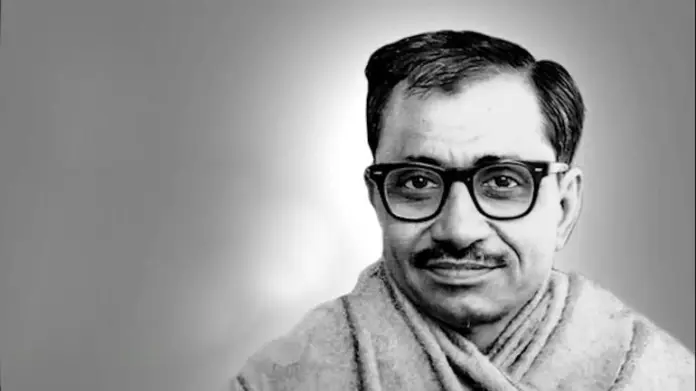
- Prime Minister Narendra Modi has paid tribute to Pandit Deendayal Upadhyaya (1916–1968) on his birth anniversary.
Pandit Deendayal Upadhyaya (1916–1968)
- He was a political thinker, economist, and leader of the Bharatiya Jana Sangh.
- He was an exceptional scholar and dedicated nationalist.
- Ideology – He was a visionary thinker, known for his doctrine of Integral Humanism (Ekatma Manav Darshan) which emphasized a balance between spiritual and material development and promoted decentralization and self-reliant village-based economy.
- Contributions- He contributed to ideological journalism by starting ‘Rashtra Dharma’ (monthly), ‘Panchajanya’ (weekly), and ‘Swadesh’ (daily).
Hurricane Polo (DDN)
Geography & Environment
News –
- Hurricane Polo, a powerful Category 4 storm, rapidly intensified over the eastern Pacific Ocean off the southwestern coast of Mexico.
About
- Hurricane Polo: A Category 4 tropical cyclone that rapidly intensified over the eastern Pacific Ocean off the southwestern coast of Mexico.
- Hurricane: Tropical cyclone with maximum sustained winds ≥119 km/h (74 mph).
- Associated weather: Heavy rainfall, thunderstorms and strong winds.
- Category 4: Indicates extremely powerful winds and potentially severe damage.
DURGA Scheme
Government Schemes
News
- Delhi Cabinet approved the Driving Upliftment and Rozgar for Women/Transgender Green E-Auto (DURGA) scheme
DURGA Scheme
- Full form: Driving Upliftment and Rozgar for Women/Transgender Green E-Auto (DURGA).
- Launched by: Delhi Government.
- Key provision: Distribution of 1,300 “Pink” electric auto-rickshaws across Delhi’s revenue districts.
- Beneficiaries: Women and transgender individuals.
- Objectives:
- Promote dignified self-employment and income generation.
- Encourage asset ownership among marginalised genders.
- Promote clean and sustainable urban transport through e-autos.
- Significance: Combines gender empowerment + livelihood generation + green mobility.
-
Article 22(1) Safeguards Against Unconstitutional Arrest | Visegrád Group (V4) | Maharashtra Women Farmers Empowerment Act, 2026 | Outer Space Treaty | India International Water Week | ADMM-Plus
Article 22(1) Safeguards Against Unconstitutional Arrest
Polity
News –
- In Jaskaran Jeet Singh Deol v. State of Punjab (2026), the Supreme Court strengthened the safeguards under Article 22(1) and set out conditions for re-arrest.
Jaskaran Jeet Singh Deol v. State of Punjab (2026)
- Supreme Court: Strengthened safeguards under Article 22(1) regarding arrest and re-arrest.
- Article 22(1):
- An arrested person must be informed of the grounds of arrest.
- Has the right to consult and be defended by a legal practitioner of their choice.
- Re-arrest: The Court laid down safeguards/conditions to prevent arbitrary or repeated re-arrest after release.
- Significance: Reinforces personal liberty, due process and constitutional protection against arbitrary arrest.
Visegrád Group (V4)
International
News –
- Visegrád Group (V4) backed India’s bid for a permanent seat on the UN Security Council at the first V4-India Foreign Ministers’ Meeting on the sidelines of the 81st UN General Assembly.
Visegrád Group (V4)
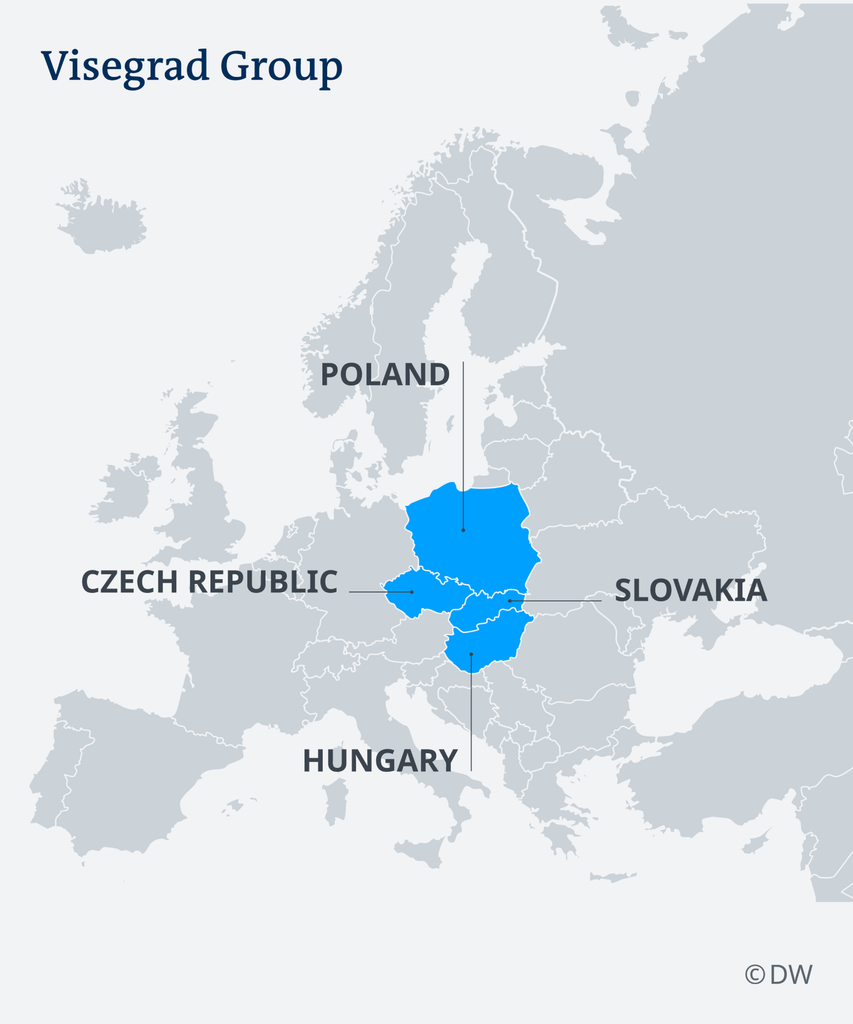
- V4: Informal intergovernmental grouping of 4 Central European countries for political, economic, cultural and security cooperation.
- Origin: Founded in 1991 as the Visegrád Triangle by Czechoslovakia, Hungary and Poland through the Visegrád Declaration in Hungary.
- Members: Czech Republic, Hungary, Poland and Slovakia.
- Objectives:
- Support post-communist democratic transition.
- Facilitate members’ integration into the EU and NATO.
- Institutional structure:
- No permanent secretariat.
- Rotating annual presidency; Slovakia holds the presidency for 2026–27.
- The International Visegrad Fund, based in Bratislava, is its only formal institution; it supports cultural, educational and research projects.
- V4+: Dialogue with non-member partners such as Japan.
- India–V4: India and V4 agreed to hold annual Foreign Ministers’ meetings and an annual Business Forum.
Maharashtra Women Farmers Empowerment Act, 2026
Polity
News –
- Maharashtra Women Farmers Empowerment Act, 2026, became India’s first state law recognising women as farmers irrespective of land ownership.
Maharashtra Women Farmers Empowerment Act, 2026.
- Significance: Maharashtra became the first Indian state to legally recognise women as farmers irrespective of land ownership.
- Objective: Address gender-based barriers faced by women in agriculture and strengthen their access to rights, schemes and support systems.
- International Context: 2026 has been declared the International Year of the Woman Farmer by the UN General Assembly.
- Focus: Recognition of women’s contribution across agrifood systems and addressing barriers to their participation and empowerment.
Outer Space Treaty
Science & technology
News –
- The US confirmed deploying on-orbit “space control weapons” to protect its satellites from China and Russia, prompting backlash over the limitations of the Outer Space Treaty.
Outer Space Treaty (OST), 1967
- Foundational treaty governing peaceful use of outer space; 115 countries, including India, have ratified it.
- Non-appropriation: No national sovereignty/ownership over outer space or celestial bodies.
- Peaceful use: Bans WMDs/nuclear weapons in orbit and military activities on the Moon/celestial bodies.
- Responsibility & liability: States are responsible for national space activities, including private entities, and liable for damage caused by their space objects.
- Astronauts: Considered “envoys of mankind” and entitled to assistance.
- Gap: Limited regulation of conventional weapons, ASATs, jamming and space debris.
- India: Indian Space Policy 2023 + IN-SPACe; joined Artemis Accords (2023); not party to Moon Agreement (1979).
India International Water Week
Polity
News –
- Vice-President inaugurated the 9th India International Water Week (IIWW) 2026 at New Delhi.
India International Water Week (IIWW) 2026
- 9th IIWW 2026: Held in New Delhi; inaugurated by the Vice-President.
- Organiser: Ministry of Jal Shakti with Central/State governments, international organisations, industry and private sector.
- Theme: “Climate Resilient Water Management.”
- Origin: Conceptualised in 2012 as India Water Week to address global water challenges and promote sustainable solutions.
ADMM-Plus
International
News-
- Indian Naval Ships INS Sahyadri and INS Kulish reached Subic Bay, Philippines, to participate in the ASEAN Defence Ministers’ Meeting-Plus (ADMM-Plus) Joint Cooperation Activity (JCA).
ADMM-Plus
- ADMM-Plus: ASEAN + 8 Dialogue Partners platform for regional security and defence cooperation.
- Plus Countries: Australia, China, India, Japan, New Zealand, South Korea, Russia, USA.
- Purpose: Promote peace, stability, defence cooperation and interoperability.
- JCA: Brings ASEAN + Plus maritime forces together for harbour and sea-phase activities, enhancing interoperability and mutual understanding.
- India: INS Sahyadri & INS Kulish participated in the JCA at Subic Bay, Philippines.
- Annual meeting: Held annually since 2017.
Additional Information – ASEAN
- Full form: Association of Southeast Asian Nations.
- Established: 1967, Bangkok Declaration.
- Founding members: Indonesia, Malaysia, Philippines, Singapore, Thailand.
- Members: 11 — Brunei, Cambodia, Indonesia, Laos, Malaysia, Myanmar, Philippines, Singapore, Thailand, Vietnam, Timor-Leste.
- Headquarters: Jakarta, Indonesia.
- Objectives:
- Regional peace, stability and security.
- Promote economic integration and trade.
- Social, cultural and political cooperation.
- Maintain ASEAN centrality in the Indo-Pacific.
- Key frameworks: ASEAN Free Trade Area (AFTA), ASEAN Regional Forum (ARF), East Asia Summit (EAS), ADMM-Plus.
- India–ASEAN: India became a sectoral dialogue partner (1992) and summit-level partner (2002); Strategic Partnership (2012) and Comprehensive Strategic Partnership (2022).
- Importance for India: Act East Policy, Indo-Pacific engagement, trade, connectivity, maritime security and regional stability.
-
Rozgar Mela | Vande Mataram and the Right to Conscience | World Rhino Day | National Single Window System | India’s First Blue Bond Set For Launch | 12 Years of Make in India | Removal of the Chief Election Commissioner | Project Suncatcher | Mizoram Woman Farmer to Receive FAO Award
Rozgar Mela
Economy
Context
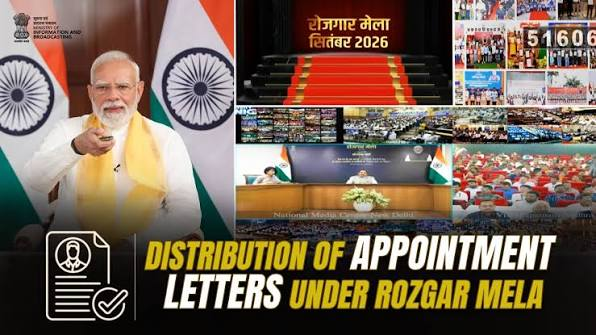
- The 20th edition of the National Rozgar Mela distributed over 51,000 appointment letters to newly inducted youth in government departments and organisations.
National Rozgar Mela
-
Launched: 2022 by the Government of India.
-
Objective: Accelerate recruitment to government posts, fill vacancies and promote youth empowerment & employment.
-
20th edition: Distributed 51,000+ appointment letters to newly recruited government employees.
-
Coverage: Ministries, Departments and government organisations.
Rozgar Mela
-
Meaning: Employment event connecting employers and job seekers for direct recruitment.
-
NSDC role: Organises Rozgar Melas with Sector Skill Councils (SSCs) and Pradhan Mantri Kaushal Kendras (PMKKs).
-
Eligibility: Generally 18–35 years; includes 8th/10th/12th pass, ITI/Diploma holders, graduates and NSQF-certified candidates.
-
Other services:
Career counselling, Kaushal Melas, MUDRA loan facilitation & skill exhibitions.
Vande Mataram and the Right to Conscience
Polity
Vande Mataram & National Song
-
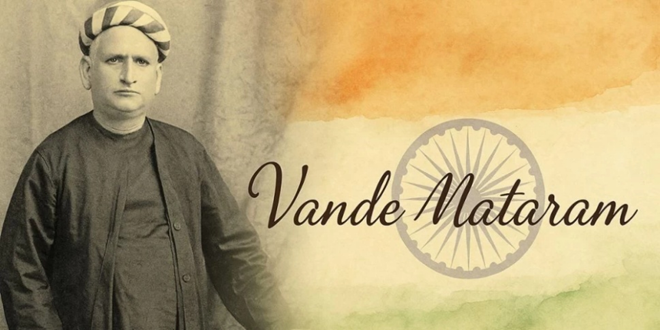
Composer: Bankim Chandra Chatterjee; composed in Sanskrit.
-
First published: Bangadarshan, 7 November 1875; later included in Anandamath (1882).
-
First sung: Rabindranath Tagore, at the 1896 INC session, Calcutta.
-
Swadeshi Movement: Became a major symbol of anti-colonial resistance in 1905.
-
National Song: On 24 January 1950, its first two stanzas were adopted as India’s National Song.
Constitutional & Legal Status
-
The Constituent Assembly accorded Vande Mataram the status of National Song, with equal honour to the National Anthem, but their legal treatment is not identical.
-
Article 51A(a): Explicitly requires respect for the National Flag and National Anthem; it does not specifically mention Vande Mataram.
-
Articles 19(1)(a) & 25: Relevant where compulsory participation conflicts with freedom of expression, conscience or religious belief.
-
Bijoe Emmanuel v. State of Kerala (1986): SC held that respectful non-participation in the National Anthem, based on genuine religious belief, is protected under Articles 19(1)(a) and 25.
Recent Legal Development
-
Prevention of Insults to National Honour (Amendment) Act, 2026: Seeks to criminalise intentionally preventing the singing of the National Song or disturbing an assembly engaged in singing it.
World Rhino Day
Species in News
In News
- World Rhino Day is celebrated globally on September 22 every year to raise awareness on the conservation of rhinoceros species.
World Rhino Day
-
Date: 22 September every year.
-
Origin: Proposed by WWF-South Africa (2010); observed internationally since 2011.
-
Coordinator: International Rhino Foundation (IRF).
-
2026 Theme: “Keep the Five Alive”.
-
Global population: ~26,700 rhinos across 5 species; 4 remain threatened.
Indian Rhino
-
Species: Greater One-Horned Rhino (Rhinoceros unicornis).
-
IUCN: Vulnerable | Wildlife Protection Act: Schedule I.
-
India: Only one of the five rhino species occurs in India.
-
Assam: Major population in Kaziranga, Manas, Pobitora & Orang; ~3,260 rhinos.
-
Kaziranga: National Park (1974) | Tiger Reserve (2006) | UNESCO World Heritage Site (1985).
Conservation Initiatives
-
Indian Rhino Vision 2020 (2005): Targeted 3,000 rhinos across at least 7 protected areas in Assam.
-
IRV 2.0 (2021): Aims to conserve
4,500–5,000 rhinos across protected areas by 2030.
National Single Window System
Polity

In News
- Recently, the National Single Window System completed 5 Years.
National Single Window System (NSWS)
- Launched: 2021
- Nodal Ministry: Ministry of Commerce & Industry
- Implemented by: DPIIT
- Purpose: Single digital platform for investors to identify, apply for and track approvals.
- Objective: Improve Ease of Doing Business and facilitate a seamless investment ecosystem.
- Coverage: Approvals from Central Ministries, State Governments & regulatory authorities.
- Key features:
- Know Your Approvals
- Common Registration Form
- Applicant Dashboard
- Document Repository
- E-Communication Module
- Significance: Reduces duplication, compliance burden and approval time through online processing, one-time submission and real-time tracking.
India’s First Blue Bond Set For Launch
Economy
Context
- Sagarmala Finance Corporation plans to raise ₹6 billion through India’s first blue bond.
India’s First Blue Bond
- Issuer: Sagarmala Finance Corporation Ltd. (SFCL).
- Plan: Raise ₹600 crore (₹6 billion) through India’s first blue bond.
- Blue Bond: Debt instrument used to finance ocean/marine-related sustainable projects.
- Purpose: Support port infrastructure, maritime development and ocean sustainability.
- Significance: Promotes sustainable financing of India’s blue economy.
12 Years of Make in India
Government Schemes

Context
- Recently, the Make in India completed its 12 years
About –
- Launched: 25 September 2014 by the Government of India.
- Nodal Ministry: DPIIT, Ministry of Commerce & Industry.
- Objective: Promote manufacturing, investment, innovation and job creation in India.
- Key focus: Ease of Doing Business, FDI promotion, infrastructure, skill development and technology adoption.
- Four pillars: New Processes, New Infrastructure, New Sectors, New Mindset.
- Make in India 2.0: Focuses on 27 sectors, including electronics, automobiles, pharmaceuticals, textiles, renewable energy and defence manufacturing.
- Significance: Seeks to make India a global manufacturing hub and integrate Indian industry with global value chains.
Removal of the Chief Election Commissioner
Polity
Context
- The Opposition is going to move a motion in Parliament seeking the removal of the Chief Election Commissioner.
Removal of Chief Election Commissioner
-
Article 324: Provides for the Election Commission of India (ECI) and its constitutional framework.
-
Removal of CEC: Can be removed in the same manner and on the same grounds as a Supreme Court judge — ensuring institutional independence.
-
Other Election Commissioners/Regional Commissioners: Removed by the President only on the recommendation of the CEC.
Removal Process
-
-
Removal motion can be introduced in either House of Parliament.
-
-
Prior support required:
-
-
Lok Sabha: ≥ 100 MPs
-
Rajya Sabha: ≥ 50 MPs
-
-
The inquiry committee investigates the allegations after admission of the motion.
-
If charges are proved, both Houses must pass the motion by a two-thirds majority of members present and voting.
-
After approval by both Houses, the President issues the removal order.
Key Point: No CEC has so far been successfully removed by Parliament.
Project Suncatcher
Science & Technology

Context
- Google has announced Project Suncatcher, to test whether AI computing infrastructure can be deployed in space, beginning with an orbital test of Google’s Tensor Processing Units (TPUs).
Project Suncatcher
- Initiative: Google’s project to develop space-based AI computing infrastructure.
- Concept: Deploy TPUs (AI processors) on satellites in LEO.
- Partner: Planet for prototype satellite development.
- Connectivity: Free-Space Optical (FSO) links using laser beams for high-bandwidth data transfer.
- Vision: Satellite constellation functioning as distributed AI computing infrastructure.
- Significance: Could enable AI processing in space, reducing dependence on terrestrial data centres.
Mizoram Woman Farmer to Receive FAO Award
Miscellaneous

News-
- Z T Lalrithangi: Farmer from Mizoram, recognised by FAO for her contribution to strawberry cultivation and rural development.
- Recognition: Among 100 women from 131 countries, selected from 600+ nominations; 2 women from India were selected.
- Occasion: Part of the International Year of Women Farmers 2026.
FAO
- Established: 1945; UN specialised agency working to end hunger and improve food and agriculture.
- Headquarters: Rome, Italy.
- Members: 194 — 193 countries + European Union.