Author: Ramvilas

  • Dahi Handi Festival | Communal Award | Electronics Component Manufacturing Scheme (ECMS) | MQ-9B Sea Guardian Unmanned Aircraft | Draft SHANTI Rules 2026

    Dahi Handi Festival

    History & Culture

    Context

    • The Maharashtra government is seeking UNESCO Intangible Cultural Heritage recognition for the Dahi Handi festival.
    • It also plans to send ‘Govindas’, who form human pyramids during the festival, to Spain to showcase this traditional practice. 

    Dahi Handi Festival

    • Dahi Handi, held a day after Janmashtami to mark the birth of Lord Krishna.
    • It combines religious devotion with community participation and sport.
    • Participants, or Govindas, form tall human pyramids to reach and break an earthen pot filled with curd, butter, and milk.

    India-Spain Connection

      • The traditional practice of building human pyramids and towers is the common link between the Dahi Handi festival and Spain, where communities practice building human towers called castells.
    • Spain’s Catalan Castells (human towers)— is already recognized by UNESCO. 
    • Spanish teams regularly visit Mumbai and Thane to participate in the Dahi Handi festival. 


    Connect with the basics – Intangible Cultural Heritage

    UNESCO defines “intangible” as “expressions that have:

    1. Passed from one generation to another.
    2. Evolved in response to their environments.
    3. Contributed to giving us a sense of identity and continuity.
      • According to an official document by UNESCO, ‘intangible cultural heritage’ includes “oral traditions, performing arts, social practices, rituals, festive events, knowledge and practices concerning nature and the universe or the knowledge and skills to produce traditional crafts.”
    • To date, 16 Indian elements have been inscribed on the UNESCO Representative List (including Deepavali)
      1. Garba of Gujarat (2023)
      2. Durga Puja in Kolkata (2021)
      3. Kumbh Mela (2017)
      4. Navroz (2016)
      5. Yoga (2016)
      6. Traditional brass and copper craft of utensil making among the Thatheras of Jandiala Guru, Punjab (2014)
      7. Sankirtana, ritual singing, drumming and dancing of Manipur (2013)
      8. Buddhist chanting of Ladakh: recitation of sacred Buddhist texts in the trans-Himalayan Ladakh region, Jammu and Kashmir (2012)
      9. Chhau dance (2010)
      10. Kalbelia folk songs and dances of Rajasthan (2010)
      11. Mudiyettu, ritual theatre and dance drama of Kerala (2010)
      12. Ramman, religious festival and ritual theatre of the Garhwal Himalayas (2009)
      13. Kutiyattam, Sanskrit theatre (2008)
      14. Tradition of Vedic chanting (2008)
      15. Ramlila, the traditional performance of the Ramayana (2008)
      16. Deepavali (2025) – Recently added

    Communal Award

    History & Culture

    In News 

    • Recently, the anniversary of the Communal Award announcements was observed.

    Communal Award

    • Announced by – Ramsay MacDonald in August 1932.
    • Objective – It Granted separate electorates to the Depressed Classes and 71 reserved seats.
    • Also provided separate electorates for Muslims, Sikhs, Christians, Anglo-Indians and Europeans.
    • Aim: political representation and protection of minorities.

    Gandhi’s Response

    • Gandhi opposed separate electorates for the Depressed Classes, arguing they would divide Hindu society.
    • He began a fast unto death at Poona on 20 September 1932.
    • M.C. Rajah and B.G. Horniman also opposed separate electorates.

    Ambedkar’s Views

    • Ambedkar strongly supported separate electorates for the Depressed Classes.
    • He believed they needed independent political representation.
    • Initially, he refused to compromise, prioritising their interests.

    Poona Pact

    • Signed on 24 September 1932 after negotiations between Gandhi and Ambedkar.
    • Separate electorates were replaced by joint electorates.
    • Reserved seats increased from 71 to 148 in provincial legislatures.
    • The Pact became a modification of the Communal Award.
    • Political reservation for SCs continued after independence.

    Electronics Component Manufacturing Scheme (ECMS)

    Economy

    Context

    • The Ministry of Electronics and Information Technology (MeitY) approved projects collectively worth ₹7,877 crore for incentives under the Electronics Component Manufacturing Scheme (ECMS).

    Electronics Component Manufacturing Scheme (ECMS)

    • Launched: 2025 by the Government of India.
    • Objective: To develop a strong domestic ecosystem for electronic components and reduce import dependence.
    • Nodal Ministry: Ministry of Electronics & Information Technology (MeitY).
    • Outlay: ₹22,919 crore over 6 years.
    • Focus: Manufacturing of components such as PCBs, camera modules, display modules, connectors, and other electronic sub-assemblies.
    • Benefits: Attracts investment, creates jobs, strengthens supply chains and promotes Make in India.
    • Significance: Supports India’s goal of becoming a global electronics manufacturing hub.

    MQ-9B Sea Guardian Unmanned Aircraft

    Science & technology

    Context

    • The Ministry of Defence signed a contract with the U.S. General Atomics Aeronautical to lease two MQ-9B Sea Guardian High-Altitude Long-Endurance (HALE) Remotely Piloted Aircraft Systems (RPAS) for the Indian Navy.

    MQ-9B SeaGuardian Unmanned Aircraft

    • Type: High-altitude, long-endurance (HALE) remotely piloted aircraft.
    • Manufacturer: General Atomics Aeronautical Systems, USA.
    • Role: Maritime surveillance, reconnaissance and intelligence gathering.
    • Key feature: Can operate for 40+ hours and cover vast maritime areas.
    • India: The Indian Navy is acquiring MQ-9B SeaGuardians to strengthen maritime domain awareness and surveillance in the Indian Ocean Region.
    • Significance: Enhances India’s ability to monitor ships, submarines and suspicious maritime activity over long distances.
    • Note: It is an unmanned aircraft, but is remotely controlled by operators rather than being fully autonomous.

    Draft SHANTI Rules 2026

    Polity

    Context

    • Recently, the government has released the draft SHANTI Rules, 2026, 

    Draft SHANTI Rules, 2026

    • Full form – Sustainable Harnessing and Advancement of Nuclear Energy for Transforming India
    • Purpose: Operationalise the SHANTI Act, 2025 and expand India’s nuclear energy sector.
    • Private participation: Framework for greater private-sector involvement in nuclear activities.
    • Licensing: Provides for a composite licence covering the nuclear installation lifecycle.
    • Safety: Strengthens requirements for nuclear safety, radiation protection and emergency preparedness.
    • Liability: Operators must maintain insurance/financial security against nuclear damage.
    • Nuclear Liability Fund: Proposed fund supported through operator levies for compensation.
    • Technology: Facilitates use of foreign nuclear technologies, subject to Indian regulatory requirements.
    • Goal: Supports India’s target of 100 GW nuclear capacity by 2047 and net-zero by 2070.
  • Surrogate Advertisements | Saptadhara | Friedreich’s ataxia (FRDA) | Hara Mangrove Forests

    Surrogate Advertisements

    Polity

    Context

    • Maharashtra’s Food and Drug Administration (FDA) issued show-cause notices to actors alleging that their advertisement for Vimal Elaichi amounts to surrogate advertising for Vimal Pan Masala.

    Surrogate advertising 

      • It is a form of marketing used to promote products banned or limited from advertising under government regulations, such as alcohol, tobacco, and pan masala. 
    • Maharashtra has prohibited gutkha and pan masala containing tobacco or nicotine since 2012 under Section 30(2)(a) of the Food Safety and Standards (FSS) Act, 2006. 

    Misleading Advertisement Under the Consumer Protection Act 2019

    • Legal Definition (Section 2(28)) –  Any advertisement that falsely describes products, gives deceptive guarantees, or deliberately conceals material information.
    • Enforcing Body: The Central Consumer Protection Authority (CCPA) regulates violations and enforces the 2022 Guidelines to protect consumer rights.Surrogate 
    • Advertising: Strictly banned to stop restricted items (alcohol/tobacco) from using permitted shadow products (soda/cardamom) for branding.
    • Coaching Institute Crackdown: Penalises institutes that hide course details when using toppers’ photos (e.g., claiming a mock-interview student as a full-time student).
    • Greenwashing & Labels: Targets unverified, misleading eco-friendly or health claims like “100% natural” to ensure scientific accuracy.
    • Financial Penalties: Fines up to ₹10 Lakh for a first offence and up to ₹50 Lakh for subsequent violations.
    • Targeted Liability: Punishes manufacturers, publishers, and celebrity endorsers, with endorsers facing a product endorsement ban of up to 3 years.

    Saptadhara

    Economy

    News

    • Prime Minister launched a seven-point ‘Saptadhara’ reform framework to fast-track India’s goal of attaining a Viksit Bharat by 2047, 

    Saptadhara 

    1. Manufacturing Power: Scaling up quality and global integration.
    2. Agricultural Power: Boosting processing, storage, and food exports.
    3. Technology & Innovation: Advancing AI, semiconductors, and R&D.
    4. Connectivity: Enhancing multimodal logistics and infrastructure.
    5. Defence Power: Achieving self-reliance in high-tech armaments.
    6. Green & Blue Economy: Expanding renewables and ocean resources.
    7. Soft Power: Promoting culture, tourism, and heritage globally.

    Friedreich’s ataxia (FRDA)

    Health & Society

    Context

    • Many Indian communities practice consanguinity.
    • It greatly increases the risk of genetic diseases that are otherwise rare, Friedreich’s ataxia is one such disease.

    Friedreich’s ataxia, or FRDA

    • It is a genetic disorder that progressively damages the nerves and the heart.
    • The affected individuals typically begin to show symptoms between the ages of 5 and 15. 

    Symptoms: 

      • Unsteady and impaired coordination.
      • Speech slows down and slurs, swallowing becomes difficult, Hearing and vision deteriorates. 
      • Fatigued, lost sensation, eventually, most patients die relatively young, of heart disease. 
    • There is no cure.
      • FRDA is more likely when both parents carry the defective gene. 
    • FRDA is caused by mutations in the FXN gene.
    • Consanguineous marriages (marriages between relatives, such as cousins) increase the chance that both parents carry the same rare genetic mutation.

    Hara Mangrove Forests

    Environment

    Context

    • A major oil spill off the southern coast of Iran has emerged as a serious ecological threat to the Hara mangrove forests.

    Hara Mangrove Forests

    • It also known as the Qeshm–Hara mangrove forests
    • Location – It is located around Qeshm Island and the Strait of Hormuz in southern Iran.
    • They are dominated by the grey mangrove (Avicennia marina), a species highly adapted to saline coastal environments.
    • The area has been recognised as a UNESCO Biosphere Reserve.

    Mangroves  

    • Definition: A mangrove is a woody plant which lives between the sea and the land, in areas which are flooded by tides for part of the time. 
    • Halophytes – Mangroves are salt-tolerant plants, also called halophytes.
    • Climatic conditions – receiving rainfall between 1,000 to 3,000 mm and temperature ranging between 26-35°C. 
    • Ecotone – Since mangroves are located between the land and sea they represent the best example of ecotone.

    Sundarbans Location: 

    • Location – The Sundarbans Forest located on the delta of Ganga-Brahmaputra-Meghna in South Asia (India & Bangladesh).
    • Global Significance: It is the largest mangrove forest in the world. 
    • It is Recognized as a UNESCO World Heritage Site and a Ramsar Site.
  • Karnataka & Group C Current Affairs – August 10th to 14th, 2026

    Appointments

    1. SC Collegium Recommends CJs for Calcutta & Bombay HCs

    Justice R.V. Ghuge and Justice M.C. Tripathi have been recommended by the Supreme Court Collegium for elevation as Chief Justices of the Calcutta High Court and Bombay High Court, respectively. Following constitutional procedure under Article 217, Justice Ghuge (previously Acting CJ of Bombay HC) will lead the Calcutta High Court, while Justice Tripathi (from Allahabad HC) is set to become the 50th Chief Justice of the Bombay High Court.


    2. Dr. Srinivasa Kumar Tummala Appointed MoES Secretary

    Dr. Srinivasa Kumar Tummala has officially assumed charge as the new Secretary of the Ministry of Earth Sciences (MoES). With his extensive expertise in oceanography and disaster early warning systems, he will lead the ministry’s administrative and scientific mandate, overseeing critical advancements in India’s meteorological, climatological, ocean, and seismological research initiatives.

    Awards

    1. Deepak Dhar Wins 2026 Dirac Medal

    Context: Renowned Indian theoretical physicist Prof. Deepak Dhar has been awarded the prestigious Dirac Medal for his seminal contributions to statistical physics.

    Key Highlights:

    • Award: 2026 Dirac Medal (ICTP Dirac Medal)
    • Awardee: Prof. Deepak Dhar (INSA Distinguished Professor at ICTS-TIFR Bengaluru)
    • Issuing Authority: International Centre for Theoretical Physics (ICTP, Trieste, Italy)
    • Key Achievement: Honoured for his foundational contributions to statistical mechanics, particularly his pioneering work on the abelian sandpile model, self-organized criticality, and statistical physics on fractal lattices.

    About the Award:

    • Established in 1985 in honour of Nobel laureate Paul Dirac.
    • Awarded annually by ICTP to scientists who have made significant, original contributions to theoretical physics.


    2. Team India Wins 4 Medals at International Linguistics Olympiad 2026

    Context: Indian students secured four medals at the prestigious international linguistics competition held in Romania.

    Key Highlights:

    • Award: 1 Gold, 3 Bronze Medals (and 1 Honourable Mention) at IOL 2026.
    • Awardees: Shrilakshmi Venkatraman (Gold); Aarav Anil Rao, Nishanth Shankar Lakshmanan, and Advay Misra (Bronze).
    • Venue: Bucharest, Romania.
    • Key Achievement: Mentored by IIIT Hyderabad, the team successfully decoded unfamiliar languages using computational logic against competitors from over 40 countries.

    About the Competition:

    • The IOL is a global academic olympiad for secondary school students that tests logical reasoning and pattern recognition rather than prior linguistic knowledge.
    • India has participated since 2009, currently holding a cumulative tally of 37 individual medals.


    3. Sangeet Natak Akademi Awards 2024-25

    Context: President Droupadi Murmu will confer the Sangeet Natak Akademi Fellowships and Awards for 2024 and 2025 to 115 eminent artists in New Delhi, recognising their distinguished contributions to India’s performing arts.

    Key Highlights:

    • Award: Sangeet Natak Akademi Fellowships (Akademi Ratna) and Sangeet Natak Akademi Awards (Akademi Puraskar).
    • Awardees: 115 artists from across India, comprising 7 Akademi Fellows and 108 Akademi Awardees.
    • Issuing Authority: Sangeet Natak Akademi.
    • Presenter: President Droupadi Murmu at New Delhi.
    • Key Achievement: Recognises outstanding and sustained individual contributions across classical music, dance, theatre, traditional and folk arts, and puppetry.

    About the Award:

    • Established as India’s national academy for music, dance, and drama, conferring these apex national honours since 1952.
    • Akademi Ratna (Fellowship): The institution’s highest and most exclusive honour. It carries purse money of ₹3,00,000, a Tamrapatra, and an Angavastram.
    • Akademi Puraskar (Awards): Carries purse money of ₹1,00,000, a Tamrapatra, and an Angavastram.

    List of Akademi Ratna (Fellowship) Recipients 2024-25:

    S.No.

    Name of the Akademi Fellow

    Field of Art / Core Contribution

    1

    Ramlal Bareth

    Kathak (Classical Dance)

    2

    A.V. Anand

    Carnatic Music (Instrumental – Mridangam)

    3

    Rita Ganguly

    Hindustani Music & Dance (Vocalist & Dancer)

    4

    Puru Dadheech

    Kathak (Classical Dance)

    5

    Chittaranjan Jyotishi

    Hindustani Music (Classical Vocal)

    6

    Pasumarthi Rattaiah Sarma

    Kuchipudi (Classical Dance)

    7

    Sudharani Raghupathy

    Bharatanatyam (Classical Dance)


    4. 2026 Dirac Medal

    Context: Indian theoretical physicist Prof. Deepak Dhar has been awarded the prestigious 2026 Dirac Medal for his groundbreaking contributions to statistical mechanics.

    Salient Features & Key Exam Facts:

    • Inception: Instituted in 1985 by the International Centre for Theoretical Physics (ICTP) in honour of British physicist Paul A. M. Dirac.
    • Awarding Institution: International Centre for Theoretical Physics (ICTP), Trieste, Italy.
    • Prize Allocation: Medallists receive a combined prize of US$5,000.
    • Nobel Exclusion Rule: By statutory rule, the medal is not awarded to current Nobel Laureates, Fields Medallists, or Wolf Foundation Prize winners.
    • Indian Context: Prof. Deepak Dhar (only the second Indian to win this, after Ashoke Sen) is celebrated for his foundational mathematical work on the “sandpile model”, which explains complex, unpredictable behaviours in physical systems.

    2026 Awardees & Core Field Overview:

    Medallist

    Associated Nation

    Primary Field of Contribution

    Deepak Dhar

    India

    Statistical Mechanics (Sandpile Model)

    Bernard Derrida

    France

    Disordered Systems & Statistical Mechanics

    Marc Mézard

    Italy / France

    Statistical Mechanics & Optimization Problems

    Haim Sompolinsky

    Israel / USA

    Theoretical Neuroscience & Artificial Intelligence


    5. Lokmanya Tilak National Award 2026

    Context: National Security Advisor (NSA) Ajit Doval was conferred the prestigious Lokmanya Tilak National Award 2026 by Union Home Minister Amit Shah at a ceremony held in Pune, Maharashtra.

    Salient Features:

    • Conferred To: NSA Ajit Doval, India’s longest-serving National Security Advisor and founding chairman of the Multi Agency Centre (MAC).
    • Presented By: Union Home Minister Amit Shah.
    • Awarding Body: Lokmanya Tilak Smarak Trust.
    • Reason for Award: For his exceptional leadership in strengthening India’s internal and external national security apparatus, and his long-standing dedication to national service.
    • Historical Genesis: The award is presented annually on August 1, commemorating the death anniversary of the great nationalist and freedom fighter Lokmanya Bal Gangadhar Tilak. The 2026 ceremony marked his 106th death anniversary.

    Award Overview & Key Facts:

    Parameter

    Key Detail / Exam Fact

    Year of Institution

    1983

    Conferment Date

    August 1 (Death Anniversary of Lokmanya Tilak)

    First Recipient (1983)

    Socialist leader S. M. Joshi

    Notable Recent Recipients

    Nitin Gadkari (2025), Sudha Murty (2024), Narendra Modi (2023)

    Important Days

    1. World Elephant Day 2026

    • Observed Date: August 12
    • Observing Organisation: World Elephant Society & Global Wildlife Conservation Organisations
    • Objective: To raise global awareness about the urgent need for elephant conservation, protection of critical habitats, and the mitigation of existential threats such as poaching, illegal ivory trade, and human-elephant conflict.
    • Theme: “Bringing the World Together to Help Elephants”


    2. International Youth Day 2026

    • Observed Date: August 12
    • Observing Organisation: United Nations (UN)
    • Objective: To recognise the vital role of young people in driving social, economic, and sustainable development, and to encourage global cooperation in addressing challenges like unemployment, digital inequality, and climate change.
    • Theme: “Different Contexts, Common Aspirations”

    Military Exercises

    Exercise ROTOR CLAP III

    Context: The Indian Air Force (IAF) successfully concluded its week-long specialised counter-drone military drill, Exercise ROTOR CLAP III, at the Pokhran Field Firing Range in Jaisalmer district, Rajasthan.

    Salient Features & Key Exam Facts:

    • Nature & Edition: It is the 3rd edition of an indigenous, specialised rotary-wing (helicopter) operational exercise conducted exclusively by the Indian Air Force (IAF).
    • Core Theme: Centred entirely around “Counter-UAS” (Counter Unmanned Aerial Systems), focusing on detecting, tracking, and neutralising hostile drones and low-flying aerial threats in modern warfare.
    • Geographic Significance: Conducted in the harsh desert terrain of the Western Desert Sector (Pokhran) to validate live-fire missile and rocket salvos, and refine Tactics, Techniques, and Procedures (TTPs) against cross-border drone surveillance.
    • Comprehensive Operations: Beyond live firing, it integrated comprehensive tactical drills including precision strikes, aerial reconnaissance, battlefield support, troop insertion, and casualty evacuation under contested threat environments.

    Participating Helicopter Fleet Overview:

    Platform Category

    Helicopter Models

    Primary Operational Role

    Attack & Assault

    AH-64 Apache, Mi-25/35

    Anti-armour, close air support, and offensive ground attack missions

    Light Combat

    HAL Prachand (LCH)

    Indigenous combat operations and precision targeting

    Heavy & Medium Lift

    CH-47F(I) Chinook, Mi-17 V5

    Heavy-lift transport, logistics, and troop deployment

    Utility & Multi-Role

    HAL Dhruv (ALH)

    Aerial reconnaissance, surveillance, search-and-rescue, and evacuation

    Ranks & Reports

    Barclays-Hurun India Most Valuable Family Businesses List 2026

    Released By: Barclays Private Clients and Hurun India

    Key Observations:

    • Aggregate Valuation: India’s top 300 family businesses are valued at ₹138 lakh crore ($1.46 trillion), equivalent to the world’s 18th-largest economy.
    • Wealth Concentration: The top three families (Ambani, Birla, Jindal) hold ₹42 lakh crore, accounting for ~9% of India’s total listed market capitalisation.
    • First-Generation Leader: The Adani Family topped first-generation enterprises with a valuation of ₹19.57 lakh crore.

    Performance Metric (Top 10 Legacy Family Businesses):

    Rank

    Business Family

    Core Group

    Valuation (₹ Lakh Crore)

    1st

    Ambani Family

    Reliance Industries

    25.82

    2nd

    Birla Family

    Aditya Birla Group

    8.13

    3rd

    Jindal Family

    JSW Steel

    8.01

    4th

    Bajaj Family

    Bajaj Group

    7.70

    5th

    Mahindra Family

    Mahindra & Mahindra

    5.14

    6th

    Anil Agarwal Family

    Vedanta

    4.45

    7th

    Murugappa Family

    Cholamandalam

    3.06

    8th

    Nadar Family

    HCL Technologies

    2.91

    9th

    Premji Family

    Wipro

    2.72

    10th

    Dani, Choksi & Vakil Families

    Asian Paints

    2.48

    Sports

    India to Host 2030 Centenary Commonwealth Games

    Context: India has been officially awarded the hosting rights for the 2030 Centenary Commonwealth Games (CWG), which will be held in Ahmedabad. This historic milestone makes India the first Asian nation to host the prestigious multi-sport event twice.

    Salient Features & Key Exam Facts:

    • Historical Genesis: The Games were first held in 1930 in Hamilton, Canada, originally known as the “British Empire Games”. The event is held every four years.
    • The 2030 Centenary Edition: The Ahmedabad games will mark exactly 100 years since the inaugural edition.
    • India’s CWG Journey: India made its debut at the 2nd edition in 1934 (London). India previously hosted the event in 2010 in New Delhi.
    • The Commonwealth Origins: The political association traces its roots to the 1926 Balfour Declaration and was formally established by the 1949 London Declaration.

    CWG & Commonwealth Structural Overview:

    Parameter

    Key Details & Exam Facts

    Governing Body

    Commonwealth Sport (formerly Commonwealth Games Federation)

    Headquarters

    London, United Kingdom

    CWG Participation

    74 Commonwealth Games Associations (CGAs), including independent members and territories

    Commonwealth of Nations

    A voluntary political association of 56 independent and equal countries (including India) spanning Africa, Asia, the Americas, Europe, and the Pacific

    Miscellaneous

    1. Birth Anniversary of Dr. G. S. Dhillon

    Context: The Lok Sabha Speaker paid floral tributes to Dr. G. S. Dhillon, former Speaker of the Lok Sabha, in the Central Hall of Samvidhan Sadan to mark his birth anniversary.

    Salient Features & Key Exam Facts:

    • Historical Role: Dr. Dhillon was a distinguished parliamentarian, scholar, and freedom fighter who actively participated in the Indian Freedom Movement and the Kisan Movement.
    • Lok Sabha Speaker: He held the prestigious office of the Speaker during the 4th Lok Sabha (1969–71) and the 5th Lok Sabha (1971–75).
    • National Honour: He was awarded the Tamra Patra by the Government of India in recognition of his invaluable contributions to the freedom struggle.

    Political & Literary Profile:

    Domain

    Key Roles & Contributions

    Legislative Career

    Member of the Punjab Legislative Assembly (1952–67); Elected to the 4th Lok Sabha (1967).

    Journalism

    Chief Editor of the Urdu daily newspaper Sher-e-Bharat.

    Corporate/Publishing

    Managing Director of National Sikh Newspapers Ltd.

    Literary Works

    Co-editor of the Chatrik Abhinandan Granth.


    2. Sinking of MSV Faize Noore Oliya

    Context: The Indian-flagged commercial vessel, MSV Faize Noore Oliya, tragically sank in the Red Sea after being struck by a projectile off the western coast of Yemen.

    Salient Features & Key Exam Facts:

    • Incident Location: The mechanised sailing vessel (MSV) capsized near Yemeni waters (near Hodeidah).
    • Crew & Rescue Operations: The vessel carried a total of 14 seafarers. All crew members, comprising 13 Indian nationals and one Yemeni national, were successfully rescued by the Yemeni Coast Guard.
    • Safe Haven: The rescued crew was safely transported to the Port of Mokha in Yemen.
    • Geopolitical Significance: This incident underscores the escalating regional tensions and the severe risks posed to international commercial shipping lanes in the Red Sea corridor.


    3. Centenary Commemorative Stamp of Satish Gujral

    Context: To honour the birth centenary of the legendary Indian artist and Padma Vibhushan awardee Satish Gujral, the Department of Posts officially released a ₹5 commemorative postage stamp on August 3, 2026,.

    Salient Features & Key Exam Facts:

    • Release Ceremony: The stamp was unveiled by the Union Minister for Communications, Jyotiraditya M. Scindia, at Bikaner House, New Delhi.
    • Stamp Design: The stamp features a vibrant self-portrait of Gujral painted in 2010, depicting him in a contemplative pose holding a paintbrush,.
    • Multifaceted Genius: Satish Gujral was a highly celebrated painter, sculptor, muralist, architect, and writer.
    • Architectural Marvel: He is globally renowned for designing the Belgian Embassy in New Delhi, a landmark achievement in modern Indian architecture.

    Key Contributions & Literary Works:

    Domain

    Notable Works / Recognition

    Painting & Visual Arts

    The acclaimed Partition Series

    Architecture

    Designed the Belgian Embassy, New Delhi

    Literature

    A Brush with Life (Autobiography)

    Civilian Honour

    Awarded the Padma Vibhushan

  • Vaishya Tekri Stupa in Ujjain | India’s Campaign For a UN Security Council (UNSC) Seat in 2028-29 | Sri Aurobindo | Rajasthan Trees (Protection) Bill-2026

    Vaishya Tekri Stupa in Ujjain

    History & Culture

    Context

    • The Madhya Pradesh government is considering fresh excavation at Vaishya Tekri in Ujjain, where a massive Buddhist stupa probably larger than Sanchi Stupa, was partially excavated in 1938–39.

    Vaishya Tekri

    • Vaishya Tekri is a large archaeological mound located near Ujjain in Madhya Pradesh.
    • It is believed to contain the remains of a large Buddhist stupa, popularly associated with the ancient Kanipura/Kanakgiri Buddhist establishment.
    • The site has been tentatively dated to the Mauryan period, around the 3rd century BCE. The monument has traditionally been associated with Emperor Ashoka and his period of governance at Ujjain.
    • The stupa is estimated to have an approximate diameter of 350 ft and a height of 100 ft or more.

    Additional Information – The Great Stupa of Sanchi

      • A stupa is a Buddhist commemorative monument usually containing sacred relics of the Buddha or other saints.
      • Established: The stupa was commissioned in the third century BCE by Emperor Ashoka of the Maurya dynasty.
      • The stupa was subsequently enlarged and embellished during the Shunga and Satavahana periods.
      • Structure: The Great Stupa is a hemispherical dome made of stone and brick, with a central structure that is a large, raised platform containing the relics of the Buddha.
      • It is topped by a ‘harmika’ that holds the triple umbrella, or ‘chhatraveli’, which represents the three jewels of Buddhism – the Buddha, the Dharma, and the Sangha. 
      • Above the dome, there is a pillar-like structure called the chatra, which is a symbol of the Buddha’s presence and enlightenment.
    • The Stupa is a UNESCO World Heritage site and a pilgrimage destination for Buddhists from around the world.

    India’s Campaign For a UN Security Council (UNSC) Seat in 2028-29

    International Relation

    Context

    • India has launched its campaign for a non-permanent United Nations Security Council (UNSC) seat for 2028–29, with the election scheduled for June 2027.

    United Nations Security Council (UNSC)

      • It is one of the six principal organs of the United Nations
    • Objective – to maintain international peace and security. 
      • It is the only UN body empowered to issue legally binding resolutions that all UN member states are obligated to comply with under international law.
      • Structure and Composition: The Council has 15 members divided into two categories:
    • Permanent Members (P5)  with Veto Power: China, France, Russia, the United Kingdom, and the United States. 
      • A single veto from any P5 member is sufficient to block any substantive resolution, regardless of how many other members support it.
      • Non-Permanent Members (10 seats): Elected by the UN General Assembly for two-year terms, distributed geographically.
    • Headquarters: New York, USA

    Sri Aurobindo

    History & Culture

    Context

    • PM Modi paid tribute to Sri Aurobindo (15 August 1872–5 December 1950) on his birth anniversary.

    About – 

    • He received his primary education in England at St. Paul’s School, London, and King’s College, Cambridge. 
    • He returned to India in 1893 and worked for the next thirteen years in the Princely State of Baroda and as a professor in Baroda College. 

    Role in freedom struggle

    • He helped establish a series of youth clubs, including the Anushilan Samiti of Calcutta in 1902.
    • In 1906, Aurobindo was appointed the first principal of the National College in Calcutta (Bengal National College), and started to impart national education to Indian youth.
    • He was the first political leader in India to openly put forward the idea of complete independence for the country in his newspaper Bande Mataram.
    • In 1907 at the Surat session of Congress, he led along with extremists. 
    • He was arrested in 1908 in connection with the Alipore Bomb Case. 

    Yogic Life

      • Sri Aurobindo had begun the practice of Yoga in 1905 in Baroda. 
      • In 1910 he withdrew from politics and went to Pondicherry in order to devote himself entirely to his inner spiritual life and work. 
      • During his forty years in Pondicherry he evolved a new method of spiritual practice, which he called the Integral Yoga. 
    • In 1926, he founded the Sri Aurobindo Ashram.

    Literary works

      • The Life Divine, which deals with the philosophical aspect of Integral Yoga.
      • Synthesis of Yoga, which deals with the principles and methods of Integral Yoga.
    • Savitri: A Legend and a Symbol, an epic poem.
    • He also started two weeklies: the Karmayogin in English and the Dharma in Bengali.

    Rajasthan Trees (Protection) Bill-2026

    Polity

    Context

    • The Rajasthan Cabinet has approved the Rajasthan Trees (Protection) Bill-2026. 

    About

    • The Bill will regulate the felling of 29 specified tree species on non-forest land. 
    • The list includes the state tree Khejri, Rohida, Banyan, Peepal, Lasoda, Tendu, Mahua, Kair and Chironji.
    • Felling or causing the felling of a specified tree on land owned or occupied by a person will require prior permission from the authorised authority.
    • Offences under the proposed law will be cognisable and bailable. A person convicted of illegal felling may face imprisonment of up to one year, a fine of up to ₹1 lakh, or both.
    • Where a tree is removed with permission, the person will be required to plant a prescribed number of trees in the same area for each tree removed.
  • Moon Base Programme | Total Solar Eclipse | Black-necked Cranes (BNC)

    Moon Base Programme

    Science & Technology

    In News

    • US space agency NASA has invited ISRO to join its Moon Base programme building on partnership under the Artemis Accords.

    Moon Base 

    • It is humanity’s first lunar outpost, a place where astronauts will live, work, and explore near the Moon’s South Pole. 
    • NASA and its partners will build the infrastructure needed to support an enduring human presence on the lunar surface while advancing science, technology, and exploration for the benefit of all.

    Additional Information – Artemis Accord

    • Objective – These are a set of principles and guidelines for international cooperation in space exploration.
    • Status – They are not a legally binding instrument.
    • Launched by – They were announced by NASA in 2020 and named after NASA’s Artemis program which is aimed at returning humans to the Moon by the mid-2020s.
    • Members: Artemis Accords has 39 members including Australia, France, Germany, India, Japan, United Kingdom, United States of America etc.
    • India’s membership – India joined the Artemis Accords in 2023.
    • Note – Russia and China are not part of the Artemis Accords.

    Total Solar Eclipse

    Science & Technology

    Context

    • Recently, a total solar eclipse occurred, providing an important opportunity to understand celestial mechanics, the Earth–Moon system and solar phenomena.

    Solar Eclipse

    • It occurs when the Moon is between the Sun and Earth and the shadow of the Moon is cast on Earth, blocking the Sun’s light from reaching certain parts of the world.

    Solar eclipse

    • Solar eclipses are classified mainly into three types:
    • Total Solar Eclipse (Umbra): The Moon fully blocks the visible disc of the Sun. Those in the line of totality will get to experience a brief darkness in the daylight.
    • Partial Solar Eclipse (Penumbra): The Moon obscures part of the Sun, causing a ‘bite’ to be taken out of the solar disc.
    • Annular Solar Eclipse (Antumbra): When the Moon is approaching the point of its orbit farthest from Earth, its apparent size is smaller than the Sun. It therefore leaves a dazzling outer ring, commonly known as the ‘Ring of Fire’.

    Black-necked Cranes (BNC)

    Environment

    Context

    • The Bombay Natural History Society (BNHS) has sterilised over 2,950 Free Ranging Dogs (FRD) to save Black-necked Cranes (BNC) and wildlife in Ladakh.

    Black-necked Crane (Grus nigricollis)

    • It is one of the 15 crane species found worldwide
    • It is considered the only high-altitude/alpine crane species. 
    • Habitat & Distribution: In India, it is found in Ladakh and Arunachal Pradesh, particularly in high-altitude wetlands and marshes.
    • Its global range extends across the Tibetan Plateau and adjoining Himalayan regions, including China, India, Bhutan and Nepal. 
    • Population: Fewer than 100 Black-necked Cranes are estimated to remain in India, out of a global population of around 15,000. 
    • Major Threats: Predation by free-ranging dogs, changing agricultural practices, rapid and unregulated development around high-altitude wetlands.

    Conservation Status: 

      • The species receives the highest legal protection under Wildlife (Protection) Act, 1972 – Schedule I
    • IUCN Red List – Near Threatened
    • It is also protected under CITES and the Convention on the Conservation of Migratory Species
    • Near Threatened under IUCN Red List. 
    • State Bird: It is the State bird of Ladakh and holds special significance in Ladakh’s Buddhist culture. 

    Additional Information – Bombay Natural History Society (BNHS)

    • BNHS is one of the largest and oldest non-governmental organizations in India dedicated to nature conservation and biodiversity research. 
    • Founded on September 15, 1883, in Mumbai, its mission is to conserve nature through action based on research, education, and public awareness.
  • Container Manufacturing Assistance Scheme (CMAS) | Deen Dayal Upadhyaya Grameen Kaushalya Yojana (DDU-GKY) | PM-POSHAN

    Container Manufacturing Assistance Scheme (CMAS)

    Government Schemes

    Context

    • The Union Government has proposed a ₹10,000 crore Container Manufacturing Assistance Scheme (CMAS) 

    About – 

    • Launch: Announced in Union Budget 2026–27.
    • Nodal Ministry: Ministry of Ports, Shipping and Waterways.
    • Financial Outlay: ₹10,000 crore over 5 years.
    • Primary Objective: Build a self-reliant domestic shipping container ecosystem.

    Key Targets

    • Production: Scale capacity to 7.5 lakh TEUs annually.
    • Economic Value: Unlock ₹80,000 crore market opportunity.
    • Employment: 3,000 direct and 50,000 indirect jobs.
    • Scope: Supports both Greenfield and Brownfield units.

    Significance

    • Import Substitution: Reduces reliance on 2 million imported containers annually.
    • Supply Chain Resilience: insulates Indian exports from global logistics shocks.
    • Policy Synergy: Aligns with Maritime Amrit Kaal Vision 2047, PM Gati Shakti, and Make in India.

    Deen Dayal Upadhyaya Grameen Kaushalya Yojana (DDU-GKY)

    Government Schemes

    Context

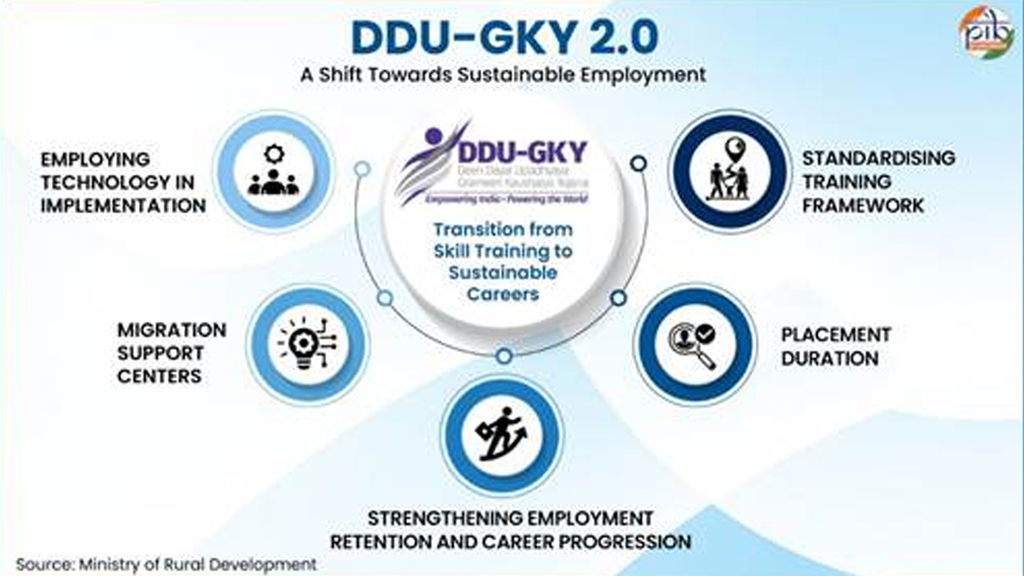
    • The Standing Committee on Rural Development has highlighted the gap between skill training and actual employment outcomes under the Deen Dayal Upadhyaya Grameen Kaushalya Yojana (DDU-GKY).

    About

    • Implementation – Ministry of Rural Development (MoRD)
    • Launched in – 2014. 
    • It is a placement-linked skill development programme under the Deendayal Antyodaya Yojana–National Rural Livelihoods Mission (DAY-NRLM).
    • Age Limit: Rural youth between 15 and 35 years of age (age limit is up to 45 years for women, SC/ST, persons with disabilities and minorities).
    • Objective – It aims to skill rural youth and promote sustainable livelihoods for rural youth through placement-linked skilling programs.

    PM-POSHAN

    Government Schemes

    In News

    • Delhi government schools will have a new menu for PM-POSHAN with additions such as idli-sambar.

    Pradhan Mantri Poshan Shakti Nirman (PM POSHAN)

    • Earlier known as Mid-Day Meal Scheme (MDMS) and renamed as PM POSHAN (Pradhan Mantri Poshan Shakti Nirman) in 2021.
    • It operates under the Ministry of Education and is approved for the period 2021-22 to 2025-26.
    • It is a centrally sponsored scheme (jointly funded by Centre and States) providing one hot cooked meal to students in government and aided schools up to Class 8.
    • It aims to address hunger (lack of adequate food intake) and educational outcomes (attendance, retention, learning) simultaneously.
  • 10 Years of Government e-Marketplace | National Youth Parliament Scheme Web Portal | Mahanadi River Water Dispute | Chandrayaan-5 | Pradhan Mantri Matsya Sampada Yojana | Nasha Mukt Yuva for Viksit Bharat Sankalp Abhiyan | Revamped Khelo India Scheme

    10 Years of Government e-Marketplace

    Polity

    Context

    • The Government e Marketplace (GeM) completed ten years of operations on 9 August 2026.

    Government e-Marketplace

    • It is India’s online public procurement portal launched in 2016 under the Ministry of Commerce and Industry. 
    • It is a 100% government-owned, not-for-profit company.

    Core Pillars

    • Inclusivity: Onboards MSMEs, startups, and women artisans.
    • Efficiency: Reduces time via paperless and cashless processes.
    • Transparency: Uses open electronic bidding to eliminate corruption.

    Key Features

    • Flexible Purchasing: Supports direct buying, e-bidding, and reverse auctions.
    • Seamless Integration: Verified via Aadhaar, PAN, GSTIN, and corporate banking.

    Major Sub-Initiatives

    • SWAYATT: Promotes startups, women, and youth-led businesses.
    • Womaniya: Showcases handicrafts made by women Self-Help Groups.
    • Startup Runway: Helps tech startups pitch products to state buyers.
    • SARAS Collection: Markets utility goods produced by rural artisans.

    National Youth Parliament Scheme Web Portal

    Polity

    Context

    • The Ministry of Parliamentary Affairs has launched an upgraded version of the National Youth Parliament Scheme web portal, known as NYPS 2.0.

    National Youth Parliament Scheme (NYPS) 

    • It is an initiative of the Ministry of Parliamentary Affairs.
    • Objective- It is aimed at promoting democratic values, parliamentary practices, and constitutional awareness among young people. 
    • Uniqueness – Unlike the previous version, which was limited to students of recognized institutions only, NYPS 2.0 is open to all educational institutions, groups and citizens across the country.

    Web Portal: 

    • The Ministry of Parliamentary Affairs launched the web portal of the NYPS in 2019.
    • Aim: To expand the outreach of the Youth Parliament Programme of the Ministry to all the recognized educational institutions of the country.

    Mahanadi River Water Dispute

    Polity

    News – 

    • The long-standing Mahanadi River water dispute between Odisha and Chhattisgarh has once again come into focus.

    Constitutional and Legal Framework 

    Inter-State River Waters

      • Article 262: Empowers Parliament to adjudicate disputes relating to inter-state river waters.
      • Inter-State River Water Disputes Act, 1956: Provides for the establishment of water dispute tribunals.
      • River Boards Act, 1956: Provides for river basin planning (though no River Board has been established under the Act).
    • Entry 17 (State List): Water is primarily a state subject.
    • Entry 56 (Union List): Parliament can regulate and develop inter-state rivers in the public interest.

    Other Inter-State River Water Disputes

    • Cauvery: Karnataka, Tamil Nadu, Kerala, Puducherry.
    • Krishna: Maharashtra, Karnataka, Telangana, Andhra Pradesh.
    • Godavari: Maharashtra, Telangana, Andhra Pradesh, Chhattisgarh, Odisha.
    • Ravi-Beas: Punjab, Haryana, Rajasthan.
    • Mahadayi (Mandovi): Karnataka, Goa, Maharashtra.
    • Vamsadhara: Andhra Pradesh and Odisha.

    Additional information – Mahanadi River

    • Origin: Sihawa Hills, Dhamtari district, Chhattisgarh. Length: Approximately 851 km.
    • States Covered: Chhattisgarh, Odisha, and a small part of Jharkhand.
    • Mouth: Empties into the Bay of Bengal near Paradip, forming a fertile delta.
    • Major Tributaries: Left Bank: Seonath, Hasdeo, Mand. Right Bank: Ong, Tel, Jonk, Ib.

    Chandrayaan-5

    Science & technology

    News – 

    • Scientists from ISRO and Japan Aerospace Exploration Agency (JAXA) recently reviewed the progress of the Chandrayaan-5.
    • Also known as LUPEX (Lunar Polar Exploration),

    About – 

    • It is a joint project between ISRO and JAXA.
    • Targeted for launch around 2028.
    • Objective – The mission focuses on exploring the Moon’s South Pole to study surface and subsurface water-ice deposits.
    • The mission will take off on a Japanese rocket, H3, and is planned to carry seven scientific instruments for carrying out different kinds of experiments.

    Additional information – Chandrayaan-3

    • It is India’s third moon mission. 
    • It was made by the Indian Space Research Organisation (ISRO). 
    • On August 23, 2023, it landed near the Moon’s South Pole. This made India the first country to reach the south polar region and the fourth country to land on the Moon. August 23 is now celebrated as National Space Day in India.

    Key Quick Facts

    • Launch Rocket: LVM3-M4 rocket.
    • Landing Site: Named Shiv Shakti Point.
    • Mission Life: 1 Lunar Day (about 14 Earth days).

    The Three Spacecraft Parts

    Propulsion Module: Carried the lander close to the Moon. It has 1 payload

    • SHAPE (Spectro-polarimetry of Habitable Planet Earth):  Studies Earth from orbit.

    Vikram Lander: The main box that made the soft landing.It has 4 payloads

    1. ChaSTE (Chandra’s Surface Thermophysical Experiment) : Measures surface temperature.
    2. ILSA (Instrument for Lunar Seismic Activity): Records moonquakes.
    3. RAMBHA-LP (Radio Anatomy of Moon Bound Hypersensitive Ionosphere and Atmosphere – Langmuir Probe) :Measures plasma density.
    4. LRA (Laser Retroreflector Array) : Measures Moon distance (NASA)

    Pragyan Rover: A small 6-wheeled robot. It has 2 payloads.

    1. LIBS (Laser-Induced Breakdown Spectroscope): Finds elements (found Sulphur).
    2. APXS (Alpha Particle X-ray Spectrometer):  Studies soil minerals.

    Why the South Pole Matters

    • Water Ice: Deep craters have ice that never melts.
    • Resources: This ice can make drinking water, oxygen, and fuel for future astronauts.
    • History: The cold preserves old solar system clues.

    Pradhan Mantri Matsya Sampada Yojana

    Government Schemes

    News- 

    • The Union Government announced that post-harvest losses in Karnataka’s marine fisheries range between 6.21% and 10.13%.

    Fisheries Sector of India

    • Producer – India is the 3rd largest fish producing and 2nd largest aquaculture producing nation in the world. 
    • India is the 4th largest exporter of fish and fisheries. 
    • In terms of employment, the sunrise sector supports the livelihood of over 30 Mn people in India. 
    • Pradhan Mantri Matsya Sampada Yojana (PMMSY)– to bring about the Blue Revolution through sustainable and responsible development of the fisheries sector in India.

    Government Initiatives for the Growth of the Sector

    • National Fisheries Development Board (NFDB): Established in 2006, NFDB serves as the apex body for the planning and promotion of fisheries development in India.
    • Pradhan Mantri Matsya Sampada Yojana (PMMSY): Launched in 2020, PMMSY is a flagship scheme aimed at boosting fish production and doubling farmers’ income.
    • Blue Revolution: Launched in 2015, the Blue Revolution aims to promote sustainable development and management of the fisheries sector.

    Nasha Mukt Yuva for Viksit Bharat Sankalp Abhiyan

    Polity

    News – 

    • Prime Minister Narendra Modi launched the Nasha Mukt Yuva for Viksit Bharat Sankalp Abhiyan to build a drug-free India through awareness and community engagement.

    About – 

      • It is a 100-week youth campaign launched on August 2, 2026. 
      • Mandate – It aims to eradicate substance abuse to achieve Viksit Bharat @2047.
    • Ministry: Ministry of Youth Affairs and Sports.
      • Platform: Conducted through Mera Yuva Bharat (MY Bharat).
      • Timeline: 100 weeks (active every Sunday).
    • Origin: Inspired by a pilot in Varanasi (Kashi Declaration).
    • Synergy: Complements the Ministry of Social Justice’s Nasha Mukt Bharat Abhiyaan.

    Key Pillars

    • Mass Mobilisation: Uses 1 crore+ youth, NSS units, and spiritual bodies.
    • Sunday Activities: Promotes sports, yoga, and arts as positive alternatives.
    • Destigmatization: Treats recovering addicts as “warriors” for social reintegration.

    Revamped Khelo India Scheme

    Government Schemes

    News – 

    • The Union Cabinet approved the revamped Khelo India Scheme and enhanced Assistance to National Sports Federations with an increased budget of ₹36,441 crore for 2026-27 to 2030-31.

    Core Changes

    • 10x Athlete Pool: Adds “Emerging Khelo India Athletes” (E-KIAs) to scale up talent enrollment
    • School Integration: Creates Khelo India Feeder Schools and Utkrishta Vidyalayas for academics-sports balance.
    • Coaching Standards: Establishes the National Coach Accreditation Board (NCAB) to unify certifications.
    • Tech-Driven Tracking: Deploys an AI-enabled digital platform for performance monitoring and scouting.

    Comparison

    Feature

    Original Scheme

    Revamped Scheme (2026–31)

    Outlay

    ~₹4,500 crore

    ₹36,441 crore

    Talent Pool

    Localized cohorts

    10x larger pool (E-KIAs)

    Coaching

    Fragmented regional rules

    Unified NCAB standards

    Pathway

    Domestic focus

    Integrated Olympic/CWG pathway

  • Karnataka & Group C Current Affairs – August 4th to 9th, 2026

    Awards

    1. COSPAR Vikram Sarabhai Medal 2026

    Context: A prominent Indian astrophysicist was globally recognized for her pioneering contributions to space research and stellar astrophysics during the 46th COSPAR Scientific Assembly in Florence, Italy.

    Key Highlights:

    • Award: COSPAR Vikram Sarabhai Medal 2026.
    • Awardee: Prof. Annapurni Subramaniam (Director, Indian Institute of Astrophysics, Bengaluru).
    • Issuing Authority: Jointly conferred by the Committee on Space Research (COSPAR) and the Indian Space Research Organisation (ISRO).
    • Venue: Florence, Italy.
    • Key Milestone: First Indian woman and only the third woman globally to receive this honor (4th Indian overall).
    • Key Achievements: Recognized for research in stellar astrophysics (blue straggler stars, star clusters), serving as calibration scientist for AstroSat’s UVIT, and leadership in the Hanle Dark Sky Reserve and Thirty Metre Telescope (TMT) projects.

    About the Award:

    • Instituted in 1990 in memory of Dr. Vikram Sarabhai, father of the Indian Space Programme.
    • Conferred biennially to recognize exceptional space research contributions by scientists from developing nations.
    • Previous Indian laureates: U.R. Rao (1996), Gurbax Singh Lakhina (2014), and Anil Bhardwaj (2024).


    2. Sarvottam Jeevan Raksha Padak Conferred on 12 Rat Miners

    Context: Twelve rat-hole miners were nationally recognized for their exceptional courage and selfless service during a critical tunnel rescue operation in Uttarakhand.

    Key Highlights:

    • Award: Sarvottam Jeevan Raksha Padak (accompanied by a miniature medal, certificate, and a ₹2 lakh monetary award).
    • Awardees: 12 rat-hole miners (Vaqeel Hasan, Munna, Ankur Kumar, Monu Kumar, Devendra, Mohd Rashid, Firoz Qureshi, Jatin Kashyap, Shorabh Kashyap, Mohd Irshad, Nasruddin, and Naseem).
    • Issuing Authority: Ministry of Home Affairs, Government of India.
    • Presenter: Union Minister for Road Transport and Highways Nitin Gadkari in New Delhi.
    • Key Achievement: Showcased exceptional bravery by voluntarily risking their lives to manually clear the final 12 meters of debris within a confined space, successfully rescuing 41 laborers trapped for 17 days in the collapsed, under-construction Silkyara tunnel in November 2023.

    About the Award:

    • Instituted in 1961 as an offshoot of the Ashoka Chakra series of Gallantry awards.
    • Conferred to recognize meritorious acts of human nature in saving the life of a person in incidents like drowning, accidents, or natural calamities.
    • The Sarvottam Jeevan Raksha Padak is the highest of the three categories, awarded for conspicuous courage under circumstances of very great danger to the life of the rescuer.

    Important Days

    1. International Clouded Leopard Day

    • Observed Date: August 4
    • Observing Organisation: Global conservation organisations / Ministry of Environment, Forest and Climate Change (India)
    • Objective: To raise global awareness about the elusive clouded leopard (Neofelis nebulosa), highlight the severe threats of deforestation and the illegal wildlife trade, and mobilize coordinated conservation efforts to protect the remaining population of fewer than 10,000 mature individuals.


    2. Hiroshima Day

    • Observed Date: August 6
      Observing Organisation: Global peace organisations and the City of Hiroshima
    • Objective: To commemorate the 81st anniversary of the 1945 atomic bombing (when the US dropped the “Little Boy” bomb), honour the victims and the survivors known as Hibakusha, and reinforce the global commitment to peace, non-violence, and complete nuclear disarmament.
    • Theme: “Remembrance, Responsibility, and Resilience”


    3. National Handloom Day (12th Edition)

    • Observed Date: August 7
    • Observing Organisation: Government of India
    • Objective: To commemorate the launch of the 1905 Swadeshi Movement, celebrate India’s diverse weaving traditions, and recognise the socio-economic and cultural contributions of 35.22 lakh handloom workers (over 72% of whom are women), aiming to converge cultural heritage with sustainable economic growth for the vision of Viksit Bharat 2047.

    Salient Features & Key Exam Facts:

    • Historical Genesis: The date marks the formal proclamation of the Swadeshi Movement at the Calcutta Town Hall on August 7, 1905.
    • Inception: The observance was officially declared by the Union Government in 2015.
    • Demographic Significance: The sector is a vital source of rural employment, supporting 35.22 lakh workers, of which 25.46 lakh (over 72%) are women.

    Key Government Schemes:

    Scheme / Initiative

    Key Exam Fact

    Weaver MUDRA Scheme

    Credit assistance provided at a concessional 6% interest rate.

    National Handloom Development Programme (NHDP)

    Integrated cluster development with financial assistance up to ₹2 crore.

    Raw Material Supply Scheme (RMSS)

    Offers a 15% price subsidy on specified yarns and reimburses freight charges.

    India Handloom Brand

    Ensures quality certification and product authenticity for premium market positioning.


    4. Quit India Movement Day (84th Anniversary)

    • Observed Date: August 8
    • Observing Organisation: Government of India / National Observance
    • Objective: To commemorate the 1942 launch of the historic Bharat Chhodo Andolan, honour the mass civil disobedience and sacrifices of India’s freedom fighters, and reaffirm the nation’s commitment to democratic values, patriotism, and unity.


    5. World Oceans Day 2026

    • Observed Date: June 8
    • Observing Organisation: United Nations (UN)
    • Objective: To honour, protect, and conserve the ocean, raise global awareness about the impact of human actions such as overfishing and pollution, and mobilize a worldwide movement for the sustainable management of marine resources.
    • Theme: “REIMAGINE: Beyond the world we know, a new relationship with our ocean”


    6. Nagasaki Day (81st Anniversary)

    • Observed Date: August 9
    • Observing Organisation: Global Peace Organisations and the City of Nagasaki
    • Objective: To commemorate the 81st anniversary of the devastating 1945 atomic bombing, honour the victims and survivors (Hibakusha), and advocate for global nuclear disarmament, arms control, and lasting peace.


    7. International Day of the World’s Indigenous Peoples 2026

    • Observed Date: August 9
    • Observing Organisation: United Nations (UN)
    • Objective: To protect Indigenous rights, celebrate their resilience, and recognise their vital contributions to environmental conservation and cultural diversity while highlighting the crucial role of traditional Indigenous knowledge in safeguarding community health.
    • Theme: “Honouring Indigenous Midwives: Safeguarding Life and Well-being”


    8. World Lion Day 2026

    • Observed Date: August 10
    • Observing Organisation: Global Wildlife Conservation Organisations (Founded by Big Cat Rescue)
    • Objective: To raise global awareness about rapidly declining wild lion populations, highlight their critical role as apex predators in maintaining ecological balance, and mobilize international efforts to mitigate threats such as habitat fragmentation, poaching, and human-wildlife conflict.

    Ranks & Reports

    Candere Hurun India Women Leaders List 2026

    Why in News: The 2026 Candere Hurun India Women Leaders List was officially unveiled, recognising 117 influential female achievers across 12 diverse sectors.

    Salient Features & Key Exam Facts:

    • Top Ranker: Meena Bindra (83 years old), the founder of the popular ethnic wear brand BIBA, secured the overall first position on the list.
    • Youngest in Top 10: Paralympic gold medallist Avani Lekhara (24 years old) secured the 6th position, making her the youngest person in the overall top 10 rankings.
    • Evaluation Criteria: The list utilizes quantitative metrics such as company valuations, annual revenues, sporting achievements, and digital presence.
    • Geographic Hubs: A significant majority of the honourees are based in the corporate and political hubs of Mumbai and New Delhi.
    • Category Leaders:
      • Oldest Leader List: Topped by Rajni Bector (86 years old) of Bectors Food Specialities.
      • Youngest Leader List: Topped by teenage Paralympian Sheetal Devi.

    Key Rankings Overview:

    Rank

    Name

    Organization / Field

    Key Exam Fact

    1st

    Meena Bindra

    BIBA

    Overall top-ranked woman leader

    2nd

    Tushara Shankar

    Lupin

    Ranked second overall

    3rd

    Rajni Bector

    Bectors Food Specialities

    Topped the Oldest Leaders category

    4th

    Vaishali Nigam Sinha

    ReNew Power

    Ranked fourth overall

    6th

    Avani Lekhara

    Paralympic Medallist

    Youngest achiever in the Top 10

    Sports

    1. India at the 23rd Commonwealth Games (2026)

    Context:

    India concluded its campaign at the 23rd Commonwealth Games held in Glasgow, Scotland, securing the fourth position globally with a total of 39 medals.

    Salient Features

    • Host City & Edition: Glasgow, Scotland (23rd Edition).
    • Overall Medal Tally: India finished 4th with 39 Medals (13 Gold, 17 Silver, 9 Bronze). Australia topped the global standings with 171 medals.
    • Boxing Dominance: Boxing emerged as India’s primary contributor, yielding a record 10 medals (7 Gold, 3 Silver)—the highest-ever gold tally for any nation in boxing at a single CWG edition.
    • Impact of Reduced Roster: The 2026 Games featured a pared-back program that excluded traditional Indian strongholds, notably wrestling, badminton, table tennis, hockey, and shooting.
    • Historic Milestones: Despite the reduced roster, India recorded first-ever CWG gold medals in Judo and secured maiden medals in the Decathlon and Para Shot Put.

    Performance & Key Achievers

    Sport / Discipline

    Athlete Name

    Medal

    Key Exam Fact / Milestone

    Weightlifting

    Mirabai Chanu

    Gold

    Secured her 3rd consecutive CWG Gold medal

    Judo

    Asmita Dey

    Gold

    First Indian to win CWG Judo Gold

    Judo

    Harsh Singh

    Gold

    First Indian man to win CWG Judo Gold

    Para-Athletics (Shot Put)

    Sharmila Dhankar

    Gold

    Secured a historic gold in Para-Athletics

    Weightlifting

    Rishikanta Singh

    Silver

    India’s first Silver medallist at the 2026 Games

    Athletics (Track)

    Gulveer Singh

    Silver

    Dual medallist (Also won Bronze in 5,000m)

    Athletics (High Jump)

    Sarvesh Kushare

    Silver

    Secured podium finish in Men’s High Jump

    Weightlifting

    Lovepreet Singh

    Silver

    Narrowly missed gold by a 1kg deficit

    Weightlifting

    Harjinder Kaur

    Silver

    Continued India’s weightlifting medal rush

    Weightlifting

    Raja Muthupandi

    Silver

    Strengthened the overall weightlifting tally

    Weightlifting

    Ajaya Babu

    Silver

    Debuted on the CWG podium

    Weightlifting

    Gyaneshwari Yadav

    Silver

    Promising debut for the young weightlifter

    Athletics (Decathlon)

    Tejaswin Shankar

    Bronze

    First-ever CWG Decathlon medal for India

    Para-Athletics (Shot Put)

    Shilpa Shyla

    Bronze

    Secured a double podium for India alongside Sharmila


    2. Anahat Singh: First Indian World Junior Squash Champion

    Context: 18-year-old Anahat Singh became the first Indian to win the World Junior Squash Championship (Girls’ Singles) at the 2026 edition in Canada.

    Salient Features & Key Exam Facts:

    • Historic Win: Defeated Egypt’s Ruqayya Salem in the final, ending Egypt’s 15-year dominance in the girls’ singles category.
    • Venue: Niagara-on-the-Lake, Canada.
    • Key Fact: Previously gained prominence in 2022 as the youngest Indian athlete (age 14) at the Commonwealth Games in Birmingham.


    3. Ajinkya Rahane Retires from International Cricket

    Context: Former Indian vice-captain Ajinkya Rahane has officially retired from all formats of international cricket.

    Salient Features & Key Exam Facts:

    • Unbeaten Captaincy: Maintained an undefeated record as India’s Test captain (6 matches), most notably leading India to a historic 2-1 Border-Gavaskar Trophy win in Australia (2020–21).
    • World Record: Holds the world record for the most catches by a fielder (non-wicketkeeper) in a single Test match (8 catches vs Sri Lanka, Galle, 2015).
    • National Award: Conferred with the Arjuna Award in 2016.
    • Domestic Record: Captained Mumbai to its record-extending 42nd Ranji Trophy title in 2024.

    Career Metrics at a Glance:

    Parameter

    Metric / Exam Fact

    Test Career

    85 Matches | 5,077 Runs (12 Centuries)

    ODI & T20I Career

    90 ODIs (2,962 runs) | 20 T20Is (375 runs)

    Test Captaincy

    6 Matches (Undefeated)

    Fielding Record

    8 Catches in a single Test (World Record)

    National Honour

    Arjuna Award (2016)


    4. Praggnanandhaa Wins Saint Louis Rapid & Blitz 2026

    Context: 20-year-old Indian Grandmaster R. Praggnanandhaa won his maiden Saint Louis Rapid & Blitz title in St. Louis, Missouri (USA), a major leg of the Grand Chess Tour (GCT).

    Salient Features & Key Exam Facts:

    • Dominant Performance: Showcased exceptional consistency by topping both the rapid and blitz segments of the tournament separately.
    • Final Score & Margin: Finished with 23.5 points (securing a $50,000 prize money award), holding a decisive 1.5-point lead over runner-up Javokhir Sindarov of Uzbekistan.
    • Tour Standings: Following this victory, Praggnanandhaa surged to the 2nd position in the overall 2026 Grand Chess Tour leaderboard.


    5. Suraj Kumar Chand Wins FISU World University Squash Title

    Context: Suraj Kumar Chand became the first Indian to win the men’s individual gold medal at the FISU World University Squash Championship.

    Salient Features & Key Exam Facts:

    • Historic Win: Defeated Hungary’s Benedek Takács in the final held in Mumbai, India.
    • Track Record: Previously won a bronze medal at the 2024 edition in Johannesburg.
    • Women’s Title: Marta Domínguez (Spain) won the women’s singles event, becoming the first woman to defend her title in the tournament’s history.
  • Bay of Bengal as India’s SHANTI Anchor | Environmental Performance Index (EPI) 2026 | INS Nipun | United to end AIDS Report | Dengue Virus | Shaheed Udham Singh

    Bay of Bengal as India’s SHANTI Anchor

    International

    News – 

    • The External Affairs Minister introduced the SHANTI framework to establish a rules-based maritime order in the Bay of Bengal (BOB) and across the Indo-Pacific.

    SHANTI Framework

    • Full form – Securing Holistic Advancement through Norms, Trust, and Integrity
    • Objective – It is India’s normative regional maritime security approach based on shared responsibility rather than a rigid military alliance.
    • Significance – The strategy aims to build long-term resilience against transnational challenges, including illegal fishing, cyber threats, and marine pollution.
    • The framework strengthens India’s position as a trusted security partner and first responder across the wider Indo-Pacific.

    Environmental Performance Index (EPI) 2026

    Environment

    News –

    • The Environmental Performance Index (EPI) 2026 was released by Yale and Columbia Universities, reviving debate on environmental governance and assessment methodologies.

    About – 

    • Objective – It assesses 177 countries through 47 indicators, weighted across Ecosystem Vitality (45%), Climate Change Mitigation (30%) and Environmental Health (25%).

    Key Highlights of EPI 2026

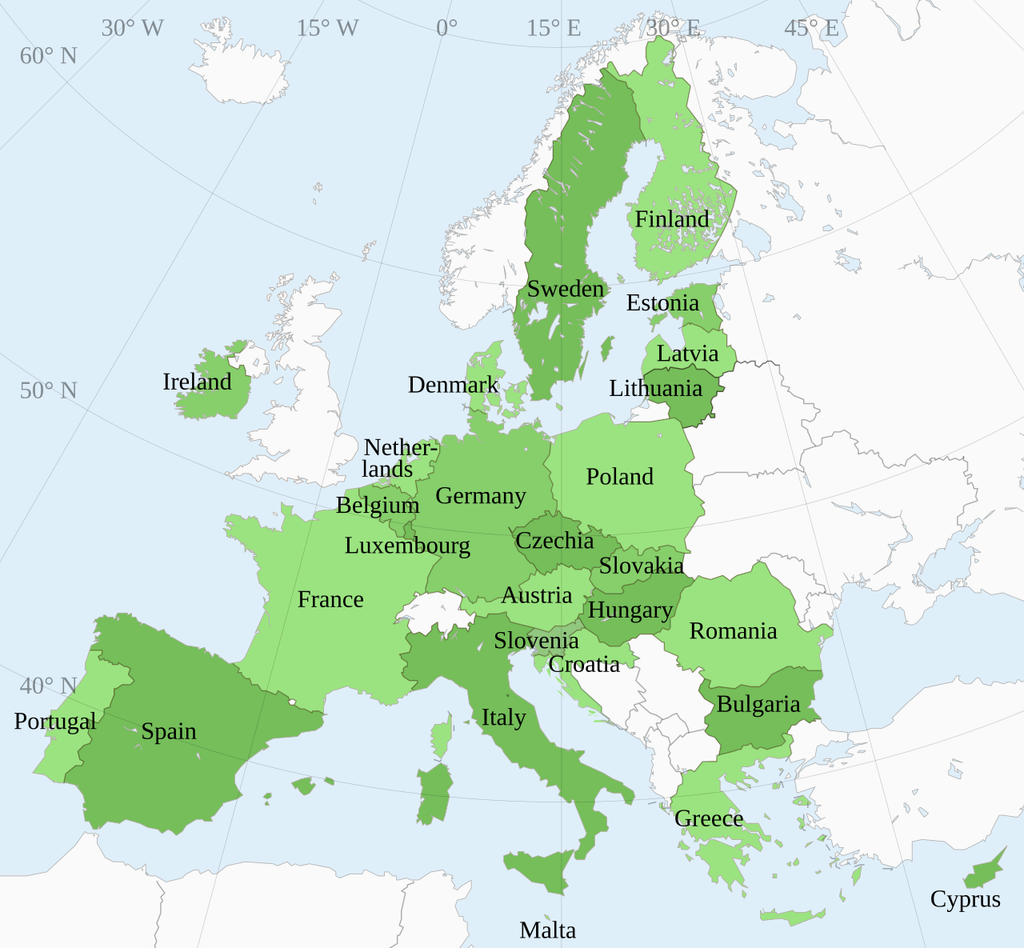
    • Global Leaders: Estonia topped the index with 74.79, followed by Luxembourg and the UK, while European countries dominated the leading positions.
    • India ranked 176th out of 177 countries, scoring 22.46, ahead of only Laos globally and last in South Asia.

    INS Nipun

    Defense

    News – 

    • Nipun, the second Diving Support Vessel (DSV) built by Hindustan Shipyard Limited, was delivered to the Indian Navy in Visakhapatnam.

    About – 

    • It is the sister ship of INS Nistar with nearly 75% indigenous content, supporting Aatmanirbhar Bharat.

    Features – 

    • Role: Deep-sea rescue, submarine salvage, and underwater security.
    • Key Asset: Serves as a mother ship for Deep Submergence Rescue Vehicles (DSRVs).
    • Specs: 118.4 metres long, 9,350 tonnes displacement.
    • Capability: Supports saturation diving up to 300 metres deep.

    United to end AIDS Report

    Health & Society

    Context (DTE):  

    • The United Nations Programme on HIV/AIDS (UNAIDS) released the report, United to End AIDS, at the 26th International AIDS Conference in Rio de Janeiro, Brazil.

    Political Declaration on HIV and AIDS (2026)

    • It is a global roadmap adopted by UN Member States in 2026, during the UN General Assembly High-Level Meeting on HIV/AIDS in New York.
    • It aims to end AIDS as a public health threat by 2030 through the 95-95-95 targets, secure US$21.9 billion annually by 2030, and protect human rights.

    Additional Information – Acquired immunodeficiency syndrome (AIDS) 

      • Pathogen – It is a chronic, potentially life-threatening health condition caused by the human immunodeficiency virus (HIV) which damages the human immune system.
      • Transmission: Through direct contact with certain body fluids (blood, semen, rectal fluid, vaginal fluid or breast milk) from a person infected with HIV.
    • Symptoms:
      • Stage 1: Flu-like illness (Fever, chills, rashes, night sweats)
      • Stage 2: Clinical latency (No particular symptoms)
      • Stage 3: AIDS (Weakening of Immune System)
    • Prevention: Prevention is better than cure, using protective techniques, non-contaminated needles & preventing mother to child transmission.
    • Treatment:  There is no cure for HIV infection. It is treated with antiretroviral drugs, which stop the virus from replicating in the body. Untreated HIV can progress to AIDS, often after many years.

    Steps taken by Government of India

    • National AIDS Control Programme (NACP) (Central Sector Scheme) 
      • India has achieved the 6th MDG of halting and reversing the HIV epidemic.
    • Prevention from Parent to Child Transmission (PPTCT) programme
    • HIV/AIDS Act 2017 (Prohibits discrimination against HIV-infected people on any grounds)
    • 90:90:90 strategy as adopted by UNAIDS (90% (diagnosed, treatment (by anti-retroviral treatment (ART)) & suppression)) by 2020. Extended by 10 years with the goal post of 95-95-95.
    • Project ACCELERATE (John Hopkin & NACO initiative): To provide HIV Services through Safe Zindagi online portal.
    • Mission Sampark: Its purpose was to “bring back” people living with HIV (PLHIV) who had stopped antiretroviral therapy (ART).

    Dengue Virus

    Health & Society

    News – 

    • Indian Council of Medical Research’s (ICMR) Virus Research and Diagnostic Laboratory (VRDL) found all four dengue virus serotypes (DENV- 1 to DENV-4) are circulating in India

    Dengue

      • Pathogen – Dengue is a viral infection caused by the dengue virus (DENV).
      • DENV is an RNA virus of the Flaviviridae family with four serotypes (DENV-1 to 4). 
    • Symptoms: High fever, severe headache, pain behind the eyes, muscle and joint pains, nausea, vomiting, swollen glands, rash. 
    • Transmission: The virus is transmitted to humans through the bites of infected female mosquitoes, primarily the Aedes Aegypti mosquito.
    • There is a possibility of maternal transmission of Dengue (from a pregnant mother to her baby), transmission via blood products, organ donation and transfusions.
    • Prevention: There is no specific antiviral treatment for dengue, so prevention relies on controlling mosquito populations and raising public awareness. 
    • The mosquitoes that spread dengue are active during the day. The best way of protection is to protect yourself from mosquito bites.

    India’s first indigenous dengue vaccine

    • DengiAll is an indigenous, tetravalent, single-dose dengue vaccine candidate being developed by Panacea Biotec in collaboration with the Indian Council of Medical Research (ICMR).

    Shaheed Udham Singh

    History & Culture

    News – 

    • Prime Minister Narendra Modi paid tribute to Shaheed Udham Singh on his martyrdom day, calling his life a symbol of courage and sacrifice that will inspire generations.

    Shaheed Udham Singh (1899-1940) 

    • He was an Indian revolutionary who avenged the 1919 Jallianwala Bagh massacre by assassinating Michael O’Dwyer, former Lieutenant Governor of Punjab.
    • Early Life: Born Sher Singh in Sunam, Punjab, he was raised at the Central Khalsa Orphanage in Amritsar, where he was renamed Udham Singh. 
    • Traumatised by the 1919 Jallianwala Bagh massacre, he dedicated his life to a struggle against colonial rule.
    • Revolutionary Ties: He joined the Ghadar Party to mobilise overseas Indians. Influenced by Bhagat Singh, he returned to India in 1927 to work with the Hindustan Socialist Republican Association (HSRA).
    • Assassination: Singh shot and killed Michael O’Dwyer at Caxton Hall, London, in March 1940, as a punishment for his support of the 1919 Amritsar massacre.
    • Secular Identity: In custody, he adopted the name “Ram Mohammad Singh Azad,” blending India’s major religions with Azad (Freedom) to symbolise anti-colonial unity.
    • Martyrdom: After a 42-day hunger strike in Brixton Prison, he was hanged at Pentonville Prison on 31 July 1940. His remains were repatriated to India in 1974.
  • India’s First Caste Enumeration in Ladakh | Rabindranath Tagore | Roselle (Hibiscus sabdariffa) | Mecca Joint Defense Agreement | Grievance Redressal Assessment & Index | Har Ghar Tiranga 2026 | Cabinet Secretary | Asan Wetland Conservation Reserve | PM-KISAN | Phoenix Species Project | Appointment of the UN Secretary-General

    India’s First Caste Enumeration in Ladakh

    Polity

    Context

    • Ladakh will become the first place in independent India to enumerate caste as part of a regular Census in the Census 2027.

    Census in India

    • Definition – A census is a survey of the population of an area that includes collecting details of a country’s demographics including age, sex and occupation.
    • History: Under W.C. Plowden, the Census Commissioner of India, first census was conducted in 1881.
    • Independent India’s first census was held in 1951 and since then it has happened in the first year of every decade.
    • The Constitution mandates that enumeration is carried out but the Census of India Act of 1948 does not specify its timing or periodicity.
    • Census is conducted by – Registrar General and Census Commissioner of India which functions under the Ministry of Home Affairs.

    Rabindranath Tagore

    History & Culture

    News – 

    • The Home Minister offered salutations to Rabindranath Tagore on his death anniversary.

    Rabindranath Tagore

    • He was the youngest son of Debendranath Tagore (leader of Brahmo Samaj)
    • He was a Bengali poet, song composer, and painter.
    • He was born in Calcutta on May 7, 1861 and died on August 7, 1941, Calcutta.
    • Awards: Became the first non-European and first lyricist to receive the Nobel Prize in Literature in 1913 for his work Gitanjali (1912).
    • He was awarded a knighthood in 1915, but he repudiated it in 1919 as a protest against the Amritsar (Jallianwala Bagh) Massacre.
    • Contribution to Education: In 1901 Tagore founded an experimental school in rural West Bengal at Shantiniketan (“Abode of Peace”), where he sought to blend the best in the Indian and Western traditions.
    • He settled permanently at the school, which became Visva-Bharati University in 1921.
    • Contribution in Freedom Movement: He was a prominent leader particularly during partition of Bengal (1905), and two of his compositions became the national anthems of India (Jana Gana Mana) and Bangladesh (Amar Sonar Bangla).
    • Key Literary Works: Sonar Tari (1894), Manasi (1890), Chitra (1914), The Post Office (1914), Nastanirh (1901), Chokher Bali (1903) Noukadubi (1906), Gora (1910), Ghare Baire (1916) and Shesher Kabita (1929).

    Roselle (Hibiscus sabdariffa)

    Environment

    News – 

    • Roselle was highlighted on International Day of the World’s Indigenous Peoples (August 9) for its nutritional security and climate resilience.

    About

    • It is native to Africa and cultivated across tropical and subtropical Asia, Africa, and the Americas. 
    • In India, it’s mainly grown by indigenous and tribal communities.
    • Commonly called Mesta or Chukur in India, it is also known as Bhenda Dal in Odisha’s Malkangiri, Gongura in Telugu, and Patwa in Hindi.
    • Nutritional Value: Provides vitamin C, iron, and calcium; its red calyces are rich in anthocyanins, which are antioxidants and offer cardiovascular and liver benefits.
    • Economic Uses: The fleshy calyces make herbal teas, jams, and pickles; stalks provide Mesta fiber for commercial use or as a raw jute substitute.

    Mecca Joint Defense Agreement

    International

    Context (IE): 

    • Saudi Arabia, Türkiye, and Pakistan signed the Mecca Joint Defense Agreement, creating a trilateral mutual-security framework.

    About – 

    • The agreement expands the 2025 Saudi Arabia-Pakistan Strategic Mutual Defense Agreement (SMDA) by incorporating Türkiye into the security framework.
    • Geopolitical Drivers: Declining confidence in US security guarantees, Saudi diversification efforts beyond Western dependence, and Türkiye’s pursuit of wider regional influence.

    Key Features:

    • Collective Deterrence: An armed attack against any member will be treated as an attack against all three, resembling NATO’s Article 5.
    • Defense-Industrial Cooperation: Expands military coordination, defense-industrial collaboration, and joint security planning to strengthen interoperable, self-reliant defense capabilities.
    • Implications for India: The pact complicates India’s West Asian diplomacy by linking Saudi Arabia, a key partner, to Pakistan and Türkiye.

    Grievance Redressal Assessment & Index

    Polity

    News – 

    • The Department of Administrative Reforms and Public Grievances released its 50th Centralized Public Grievance Redress and Monitoring System (CPGRAMS) report featuring the GRAI for June 2026.

    Grievance Redressal Assessment & Index 

    • It is a periodic evaluation framework launched by the Department of Administrative Reforms and Public Grievances (DARPG) in India.
    • Mandate – It ranks central ministries and departments based on how efficiently and timely they resolve public complaints submitted via CPGRAMS.

    GRAI evaluates organizations using 11 key indicators spread across four main dimensions:

    1. Efficiency: Time taken to dispose of and clear pending grievances.
    2. Feedback: Citizen satisfaction levels and feedback quality.
    3. Domain: Performance relative to the specific sector or service area.
    4. Organisational Commitment: Institutional resources and top-level monitoring dedicated to fixing issues.

    Centralised Public Grievance Redress and Monitoring System (CPGRAMS)

    • It is India’s 24/7 online portal for citizens to lodge, track, and appeal grievances against public authorities. 
    • It is managed by the Department of Administrative Reforms and Public Grievances (DARPG) under the Ministry of Personnel, Public Grievances & Pensions.

    Features

    • Unified Portal: Links 92 Central Ministries/Departments and all States/UTs.
    • Strict Timeline: Mandates grievance resolution within 21 days.
    • Appeal Window: Citizens can appeal unsatisfactory closures to an Appellate Authority.
    • Tech Integration: Features 22-language support via the AI-powered BHASHINI platform.

    Excluded Issues- The portal does not accept complaints regarding:

    • Sub-judice court matters.
    • RTI queries or appeals.
    • Service matters of government employees.
    • Religious issues.
    • National security threats.

    Har Ghar Tiranga 2026

    History & Culture

    Context (PIB): 

    • The Ministry of Culture launched the nationwide Har Ghar Tiranga 2026 campaign in New Delhi, which will be observed across the country from 9 to 17 August 2026.
    • The Ministry of Culture also launched SURYAPATH TIRANGA, a flagship initiative under the Har Ghar Tiranga 2026 campaign. 
    • The National Flag will be ceremonially hoisted in succession from east to west across Indian Missions worldwide, symbolically travelling with daylight across the globe.
    • Har Ghar Tiranga 2026 is dedicated to the Spirit of Vande Mataram.

    Har Ghar Tiranga

      • Campaign that started in 2022 under the aegis of Azadi Ka Amrit Mahotsav to encourage people to bring the Tiranga home and to hoist it to mark India’s independence.
      • Aim: To invoke feelings of patriotism in the hearts of citizens and promote awareness about our national flag.
    • Nodal Ministry: Ministry of Culture

    Cabinet Secretary

    Polity

    News – 

    • The Appointments Committee of the Cabinet (ACC), headed by the Prime Minister, approved a one-year extension for Cabinet Secretary Dr. T.V. Somanathan.

    Cabinet Secretary 

      • He is the senior-most civil servant and administrative head of the Cabinet Secretariat, under the direct charge of the Prime Minister.
      • He serves as ex officio Chairman of the Civil Services Board.
      • He is regarded as primus inter pares (first among equals) among Union secretaries. He ranks 11th on the Indian Order of Precedence.
      • Mandate: He acts as principal administrative adviser to the PM and Cabinet, ensures inter-ministerial coordination, and heads the National Crisis Management Committee (NCMC).
      • Appointment: ACC appoints him for a standard 2-year tenure, extendable up to 4 years. To extend beyond 4 years, the government must relax the relevant service rules on a case-by-case basis.
    • Sir Narayanan Raghavan Pillai was the first Cabinet Secretary of independent India.

    Asan Wetland Conservation Reserve

    Environment

    Context (TH): 

    • The Supreme Court ruled that a 10-km mining buffer zone now applies to all wetland reserves across India, expanding the earlier safeguard for the Asan Wetland Conservation Reserve.

    Asan Wetland

    • Locally called Dhalipur Lake
    • It is a human-made freshwater lake in Dehradun, Uttarakhand, formed by the Asan Barrage at the Asan and Yamuna Rivers confluence.
    • Designated a Ramsar Site (Uttarakhand’s first) in 2020, and is listed as an Important Bird Area (IBA) by BirdLife International.
    • Biodiversity: It is a vital wintering habitat and stopover along the Central Asian Flyway, supporting 330 bird species, including threatened vultures, Pallas’s Fish-eagle, and migratory waterbirds.
    • It serves as a spawning ground for aquatic biodiversity, supporting the endangered Golden Mahseer.

    PM-KISAN

    Government Schemes

    News- 

    • Union Cabinet extended the Pradhan Mantri Kisan Samman Nidhi (PM-KISAN) 

    Scheme to 2030–31, with an outlay of ₹3.15 lakh crore for the period.

    Pradhan Mantri Kisan Samman Nidhi (PM-KISAN)

    • Launched on – February 24 in 2019.
    • Financing – Central Sector Scheme with 100% funding from the Government of India.
    • Implementation – Ministry of Agriculture and Farmers Welfare.

    Key feature 

    • Objective – The Centre transfers an amount of Rs 6,000 per year, in three equal installments, directly into the bank accounts of all landholding farmers irrespective of the size of their land holdings.
    • Financial assistance – It provides financial assistance to the  Small and Marginal Farmers (SMFs) in procuring various inputs to ensure proper crop health and appropriate yields.
    • Identification of beneficiary – Responsibility of identification of beneficiary farmer families is entrusted with the State / UT Governments.

    Phoenix Species Project

    Environment

    News – 

    • Phoenix Species Project launched a global effort to bring 100 of the world’s most threatened species back from the brink.

    About the Project

    • Purpose: It is a global effort to recover 100 of the world’s most threatened species by providing sustained support for local champions and offering sustained funding.
    • Genesis: Launched in August 2026 

    Key Features:

    • Founders: Bezos Earth Fund and Re:wild (Leonardo DiCaprio).]
    • Target: 100 species listed as Critically Endangered or Extinct in the Wild on the IUCN Red List.
    • Knowledge Partner: IUCN Species Survival Commission.
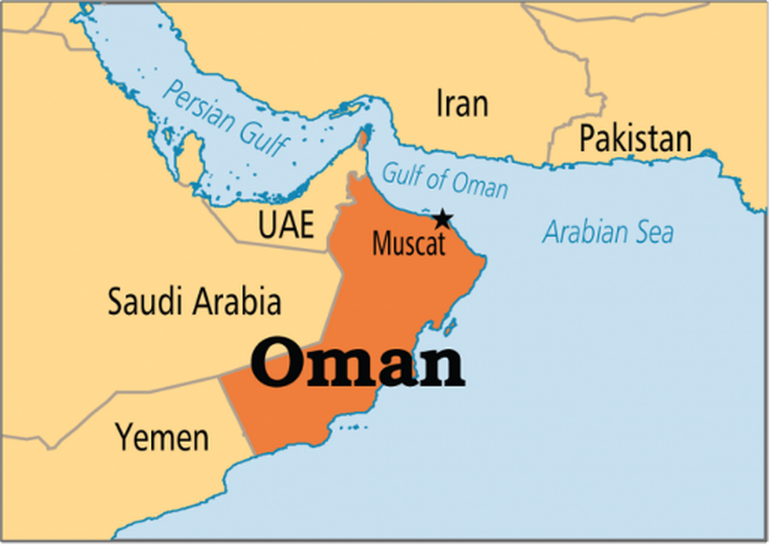
    • Global Alignment: Directly supports Target 4 of the Kunming-Montreal Global Biodiversity Framework.
    • Strategy: Focuses on long-term, locally and Indigenous-led habitat restoration, translocations, and invasive species control.

    Appointment of the UN Secretary-General

    International

    News – 

    • The United Nations Security Council (UNSC) recently held its first straw poll to select the next UN Secretary-General (UNSG), whose five-year term will begin on 1 January 2027.

    Secretary-General as the UN

    • The Secretary-General is the UN’s Chief Administrative Officer, who oversees the work of the UN Secretariat and fulfills any other functions entrusted by the organisation’s principal organs. 

    Elections: 

    • Secretary-General is appointed by the General Assembly on the recommendation of the Security Council. 
    • This means that the Permanent Members of the Security Council – China, France, Russia, the U.K., and the U.S. have a significant say in who gets elected.

    Key Principal Organs of the UNO:

      • United Nations General Assembly (UNGA): The main deliberative, policymaking, and representative organ, where all 193 member states have equal representation.
      • United Nations Security Council (UNSC): Responsible for maintaining international peace and security, with 15 members (5 permanent with veto power, 10 non-permanent).
      • Economic and Social Council (ECOSOC): Coordinates economic, social, and environmental work of the UN system, overseeing specialized agencies.
      • International Court of Justice (ICJ): The principal judicial organ, settling legal disputes submitted by states, located at The Hague.
      • Secretariat: Carries out the day-to-day work of the UN, administered by the Secretary-General.
      • Trusteeship Council: Established to supervise trust territories, it suspended operations in 1994 after Palau gained independence.
      • Headquarters: New York (UNGA, UNSC, ECOSOC, Secretariat, Trusteeship Council) and The Hague (ICJ).
    • Membership: 193 member states (all part of UNGA).